
AI Doctor vs a Real Doctor: Can AI Really Replace Your Physician?
An AI doctor can answer your health questions in seconds, explain a lab result in plain English, and help you decide whether a symptom is worth worrying about — but it cannot replace your physician. According to the American Medical Association, today’s AI is best understood as a support tool, not a licensed clinician: it does not examine your body, does not carry medical-legal accountability, and does not provide a diagnosis.

An AI doctor is not a substitute for a licensed physician and does not provide a diagnosis. For medical emergencies call 911. Use it to prepare for a real visit — not to skip one.
The Short Answer: AI Complements Doctors, It Doesn’t Replace Them
The medical consensus in 2026 is augmentation, not replacement. Nearly two-thirds of U.S. physicians (66%) reported using healthcare AI in 2024, up from 38% in 2023, according to an AMA physician survey. But the doctors using it treat it as an assistant, not a decision-maker. As then-AMA President Jesse M. Ehrenfeld put it in 2023:
AI is not going to replace doctors — but doctors who use AI will replace those who don’t.
Jesse M. Ehrenfeld, MD, AMA President 2023–2024
Even in tasks where an AI health assistant is genuinely impressive — summarizing symptoms, drafting patient-friendly explanations, flagging what to ask at your next appointment — the final call and the responsibility for it stay with a licensed physician. Clinical judgment, built from years of training and direct patient contact, is not something a language model carries.
Where an AI Doctor Is Genuinely Strong
An online AI doctor earns its place in modern healthcare precisely because it removes friction that real clinics can’t: no waiting room, no appointment slot, no per-minute clock. That strength shows up differently depending on whether you’re measuring access or the quality of the answer itself.
Access, speed and cost
An AI health assistant is available 24/7, answers in plain language, and typically costs $20–50 per consultation compared with $200–400 for an in-person specialist visit. That gap makes it a natural first stop for questions like “what does this symptom mean,” “how urgent is this,” or “what should I ask my doctor about this.” None of those questions require a physical exam or a prescription — they require information, fast.
Clear, patient-friendly, surprisingly empathetic answers
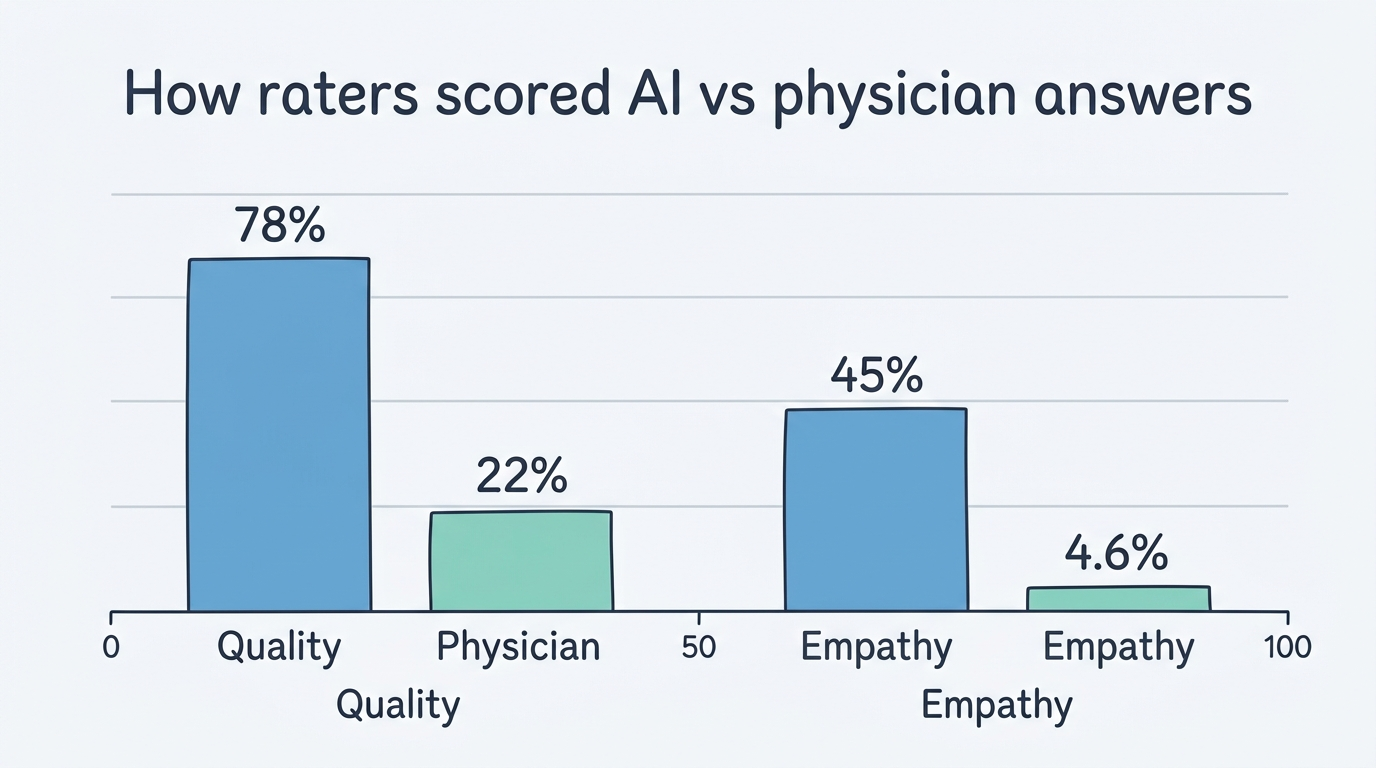
A widely cited study published in JAMA Internal Medicine in 2023, and later discussed by Harvard Health Publishing, had a panel of clinicians blindly compare AI-generated answers to physician answers on patient questions posted online. The panel rated AI responses “good or very good” in 78% of cases, versus 22% for physician responses, and rated them “empathetic or very empathetic” 45% of the time versus just 4.6% for doctors. AI answers were also longer on average — 211 words versus 52. Those numbers sound like AI won a head-to-head against real doctors, but the study measured perceived quality and tone, not medical accuracy — a distinction worth holding onto before the next section.
Where a Real Doctor Is Irreplaceable
Physical presence is not optional in medicine. A large share of clinical information — a lump felt during palpation, a wheeze heard through a stethoscope, the way someone favors one leg while walking into the exam room — never becomes text or data an AI doctor can process. No chatbot, however capable, receives that information, because the AI doctor never sees or touches the patient.

Diagnosis and prescribing are legally reserved for licensed clinicians. Only a licensed physician can order a diagnostic test, confirm a diagnosis, or write a prescription, and only a physician carries the legal and ethical accountability that comes with those decisions. A doctor also weighs your full history — rare conditions, atypical presentations, medication interactions, family history — in a way that a single chat session cannot replicate. An AI doctor can inform that conversation; it cannot stand in for it.
Accuracy: What the Studies Actually Show (and Don’t)
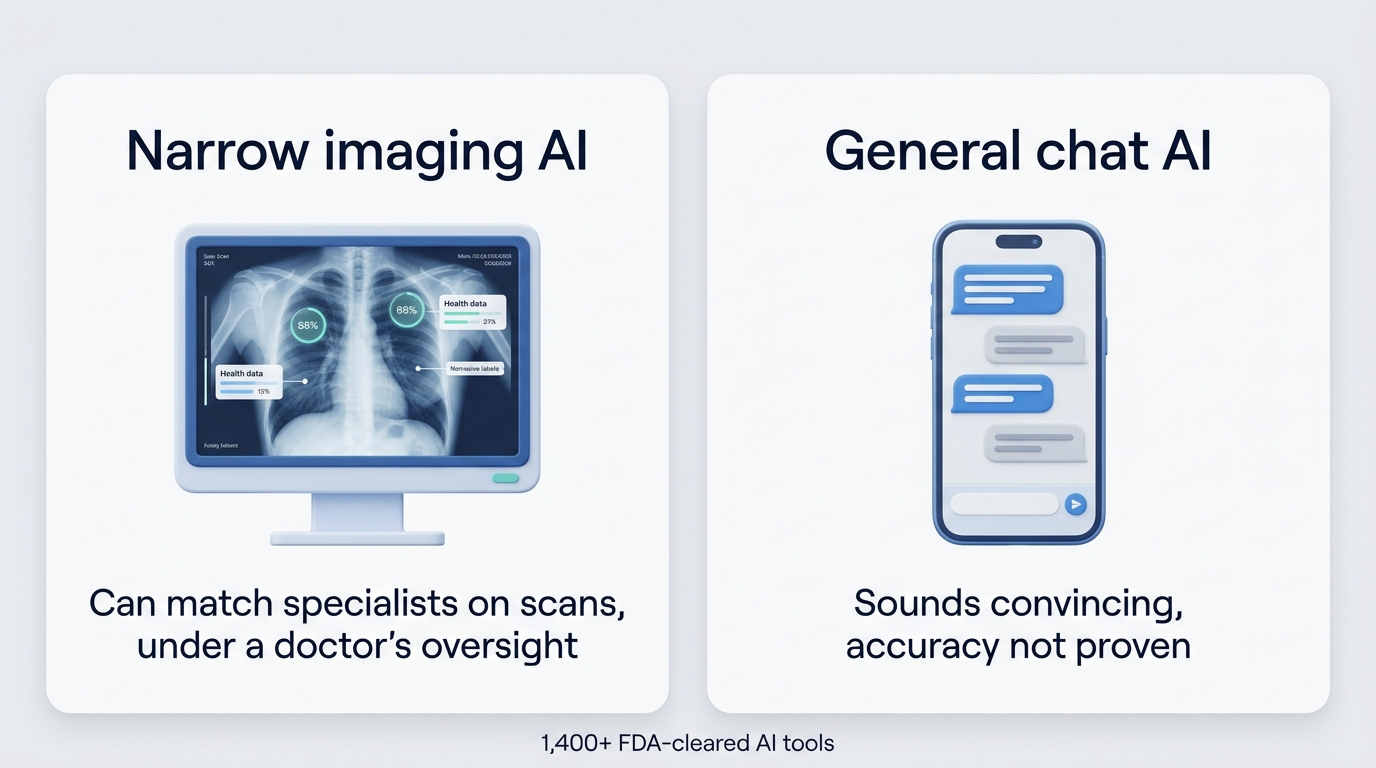
Diagnostic accuracy looks very different depending on whether you’re talking about narrow, purpose-built medical imaging AI or a general chat assistant answering open-ended health questions.
| AI type | Strongest use case | Accuracy evidence |
|---|---|---|
| Narrow imaging AI (radiology, pathology) | Detecting patterns in scans under physician oversight | 1,400+ FDA-cleared algorithms; a Google model tested on ~42,000 lung scans cut missed cancers by about 5 percentage points and false alarms by about 11 percentage points versus radiologists alone |
| General chat AI (ChatGPT-style medical chatbot) | Explaining symptoms, answering general questions | Rated highly on tone and clarity in the 2023 JAMA study, but that study did not verify medical accuracy or check for AI hallucination |
Narrow imaging AI can match or beat specialists
In tightly defined tasks like reading a chest X-ray or a mammogram, AI has real, measured wins. More than 1,400 AI-based algorithms have received FDA clearance for medical use, and a Google-developed model trained and tested on roughly 42,000 lung CT scans reduced missed cancers (false negatives) by about 5 percentage points and false alarms (false positives) by about 11 percentage points compared with radiologists working alone, per a study published in Nature Medicine. These are narrow, validated tools that operate under a physician’s supervision — a fundamentally different product than the conversational AI doctor that answers your questions online.
General chat AI: impressive answers, unproven accuracy
Harvard Health’s own review of the 78%-favorability study is blunt about its limits: the panel judged how good and empathetic the answers sounded, not whether they were medically correct, and evaluators weren’t fully blinded to which answers came from a person versus a machine. Longer answers were more likely to read as thorough and empathetic, which may have inflated AI’s score independent of accuracy. The honest takeaway is that a well-written answer is not the same thing as a correct one — and the deeper question of how accurate an AI doctor is has no comparable large-scale audit of general medical chatbots to settle it either way.
The Safety Risks You Need to Know
An AI doctor can hallucinate — producing an answer that sounds confident and authoritative but is factually wrong, with no built-in signal to warn you. It also only knows what you tell it; a detail you forget to mention, or a symptom you don’t think to describe, simply isn’t part of its reasoning — and everything you do share raises the separate question of how an AI doctor handles your data and HIPAA. The main risks worth keeping in mind are:
- Hallucination: a confident-sounding answer that is factually incorrect
- Loss of clinical judgment if you treat AI output as a final answer
- Erosion of the doctor-patient relationship from over-reliance on AI
- Privacy concerns around how health conversations are stored and used
- Missed or delayed diagnosis if AI is used in place of an exam
An AI doctor doesn’t recognize subtle red flags the way a trained clinician does, because it wasn’t trained through years of examining real patients. That’s the core reason it doesn’t replace a physician and doesn’t provide a diagnosis.
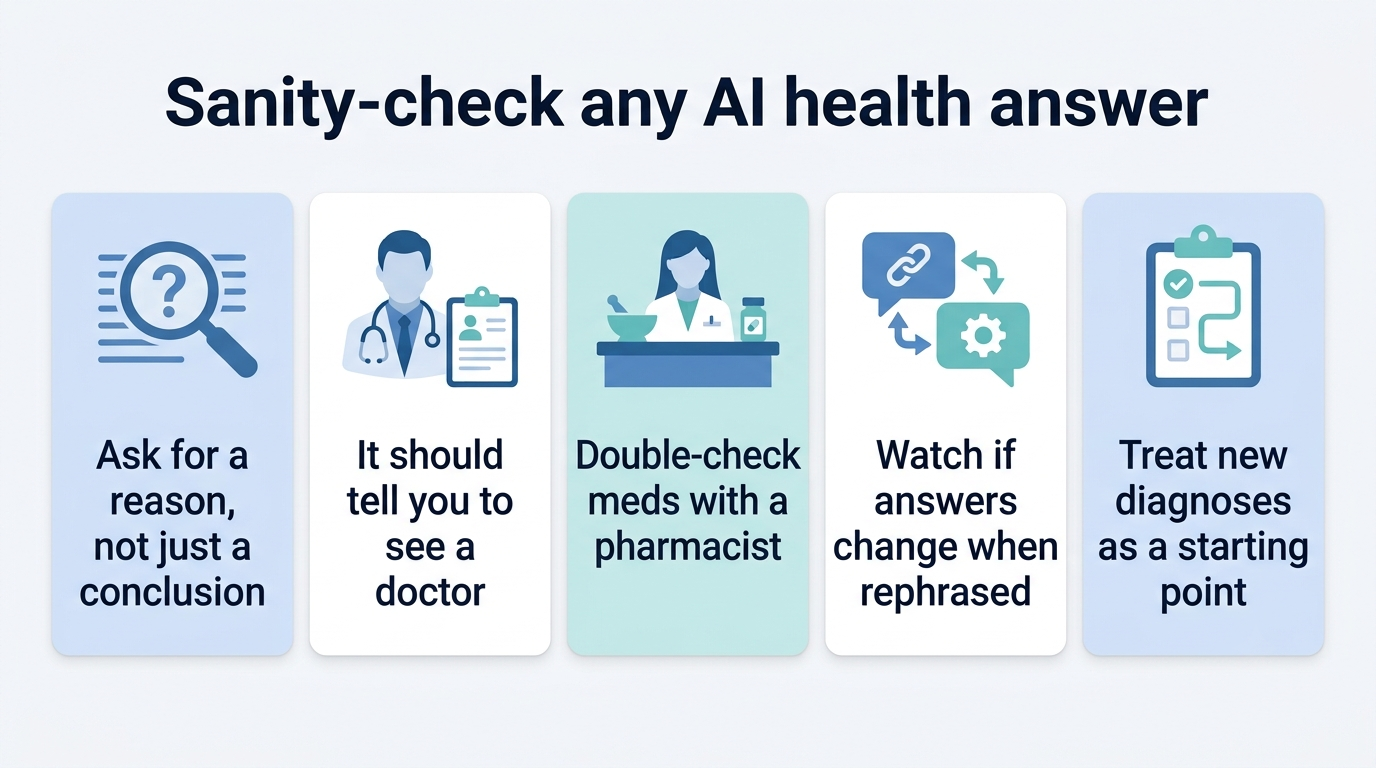
Here’s a quick way to sanity-check any answer you get from an online AI doctor before acting on it:
- Ask whether the answer cites a specific reason or just states a conclusion.
- Check if it recommends seeing a doctor for anything that sounds serious — a good AI health assistant should, not talk you out of it.
- Cross-reference any medication or dosage information with the label or a pharmacist.
- Notice if the answer changes significantly when you rephrase the same question.
- Treat any answer involving a new diagnosis or prescription decision as a starting point for a real appointment, not a final answer.
- When in doubt about severity, call your doctor’s office or use the emergency guidance below.
An online AI doctor like the AI health assistant at aidoctor.cloud is built to support that kind of careful, second-opinion use — not to replace the visit itself.
When to Use an AI Doctor vs When to See a Real One
The decision usually comes down to urgency and whether the situation needs hands-on examination, testing, or a prescription.
| Use an AI doctor | See a real doctor (or call 911) |
|---|---|
| Understanding a symptom or medical term | Chest pain or trouble breathing |
| Decoding a lab result before your appointment | Signs of stroke (sudden face drooping, arm weakness, slurred speech — FAST) |
| Preparing questions for an upcoming visit | Severe or uncontrolled bleeding |
| Judging how urgent a symptom might be | Suicidal thoughts or a mental health crisis |
| Learning about a medication in general terms | Sudden, severe, or rapidly worsening symptoms |
| — | Any new diagnosis or prescription decision |
Good uses for an AI doctor
An AI health assistant is designed for exactly these situations:
- Understanding what a symptom or medical term means
- Decoding a lab result before your appointment
- Preparing questions to ask at your next visit
- Judging how urgent a symptom might be
- Learning about a medication in general terms
Always see a real doctor (or call 911) when…
Some situations always call for immediate professional attention rather than an AI conversation:
- Chest pain or trouble breathing
- Signs of stroke — remember FAST: Face drooping, Arm weakness, Speech difficulty, Time to call
- Severe or uncontrolled bleeding
- Suicidal thoughts or a mental health crisis
- Sudden, severe, or rapidly worsening symptoms
- Any decision about a new diagnosis or prescription
As stated above: for medical emergencies call 911.
The Realistic Future: AI + Physician, Not AI Instead of Physician
The direction healthcare is actually moving in is hybrid, not either/or. Some AI-assisted telehealth services already pair an AI intake and explanation layer with a physician who reviews and signs off on the final recommendation — the AI handles the routine explaining, the physician handles judgment and accountability. Bolder predictions exist too; venture investor Vinod Khosla has argued for years that AI could eventually take over the majority of routine diagnostic work, with doctors overseeing multiple AI “interns” rather than handling every case themselves — a forecast that remains contested among physicians and researchers rather than settled fact. The AMA’s own framing is more measured: healthcare works best as “high tech and high touch” — AI expanding access and efficiency, doctors providing the judgment, accountability and human contact that AI cannot.

FAQ
An AI doctor is not a substitute for a licensed physician and does not provide a diagnosis. For medical emergencies call 911. Always consult a real, licensed doctor for diagnosis and treatment.