
Is an AI Doctor Safe? What HIPAA Really Covers and How to Protect Your Data
Before you type your symptoms into an AI doctor, it’s fair to ask who sees that data and whether HIPAA protects it. According to HHS, an AI doctor can be safe to use for general information — but most consumer AI health apps are not covered by HIPAA, so what actually protects your data is the company’s own privacy policy, not federal law.

An AI doctor is not a substitute for a licensed physician and does not provide a diagnosis. For medical emergencies call 911. This guide covers privacy, not medicine — always consult a real doctor for diagnosis and treatment.
The Short Answer: Usually Not HIPAA-Covered — Here’s Why That Matters
HIPAA binds “covered entities” — doctors, hospitals, health plans, and clearinghouses — along with their business associates, the vendors that handle protected health information on their behalf. A standalone consumer AI health app usually isn’t one of those, so it isn’t legally required to follow HIPAA at all. That doesn’t automatically make it unsafe — a separate question from an AI doctor versus a real doctor and where the two differ in capability — but it does mean your protection depends entirely on the company behind the app rather than on a federal statute, so checking is your responsibility, not a formality.
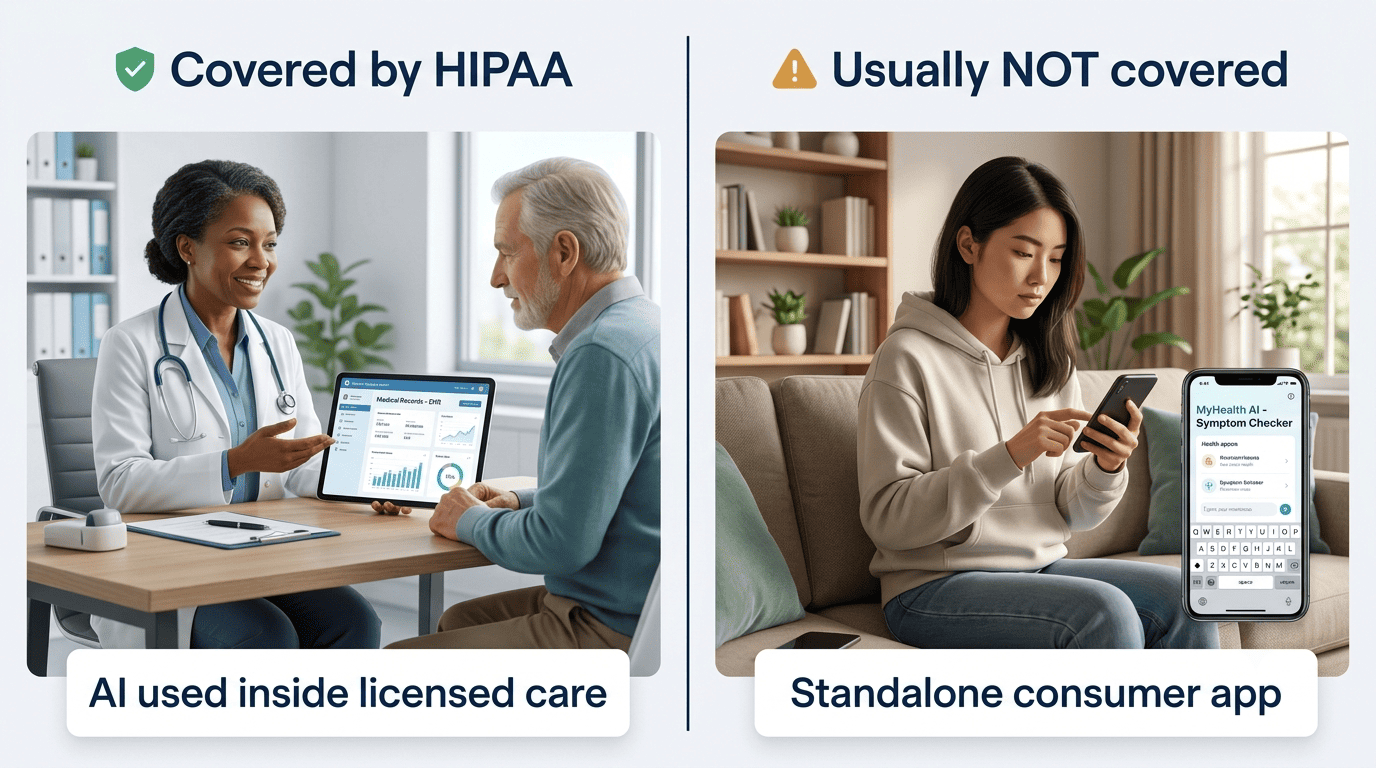
The distinction sounds technical, but it changes everything about what happens to your data. A HIPAA covered entity is legally bound by the Privacy Rule and Security Rule and faces real penalties for mishandling Protected Health Information (PHI). A consumer app with no such status answers only to its own terms of service — and those terms can be rewritten at any time.
When an AI Doctor IS Covered by HIPAA — and When It Isn’t
Whether an AI tool falls under HIPAA depends less on what it does than on who deployed it and under what agreement. The same underlying model can be HIPAA-covered in one setting and completely uncovered in another.
Covered: AI inside licensed care
An AI tool is typically covered by HIPAA when any of the following is true:
- A licensed physician or care team uses the tool during your visit or treatment.
- A telehealth platform runs on a licensed provider’s infrastructure and handles your records.
- The AI vendor has signed a business associate agreement (BAA) with a covered entity.
A BAA is a legally binding contract that extends HIPAA obligations to the vendor. Without one, no such obligation exists, no matter how the marketing reads. Once any of these conditions applies, the data you share is treated as PHI and falls under HIPAA’s Privacy and Security Rules.
Not covered: standalone consumer apps
A separate wellness or health app that you download and use on your own — where you type symptoms directly into a chat window — is typically classified as a consumer tool outside HIPAA’s reach. The company writes its own rules for how it collects, stores, and shares what you tell it, and those rules live in a privacy policy you can read before you type a single symptom.
| App type | Typical HIPAA status | What governs your data |
|---|---|---|
| AI used by your doctor during a visit | Covered | HIPAA Privacy & Security Rules |
| Telehealth platform with a licensed provider | Covered (via BAA) | HIPAA + the BAA contract |
| Standalone consumer AI health app | Usually not covered | The app’s own privacy policy |
| Free public chatbot (general-purpose) | Not covered | Standard consumer terms of service |
What HIPAA Actually Protects — and What It Doesn’t
HIPAA is built from three rules that work together:
- Privacy Rule — governs how Protected Health Information (PHI) can be used and disclosed.
- Security Rule — requires administrative, physical, and technical safeguards for electronic PHI.
- Breach Notification Rule — requires covered entities to notify affected individuals after a data breach.
Each rule matters — but every one of them applies only to covered entities and their business associates.
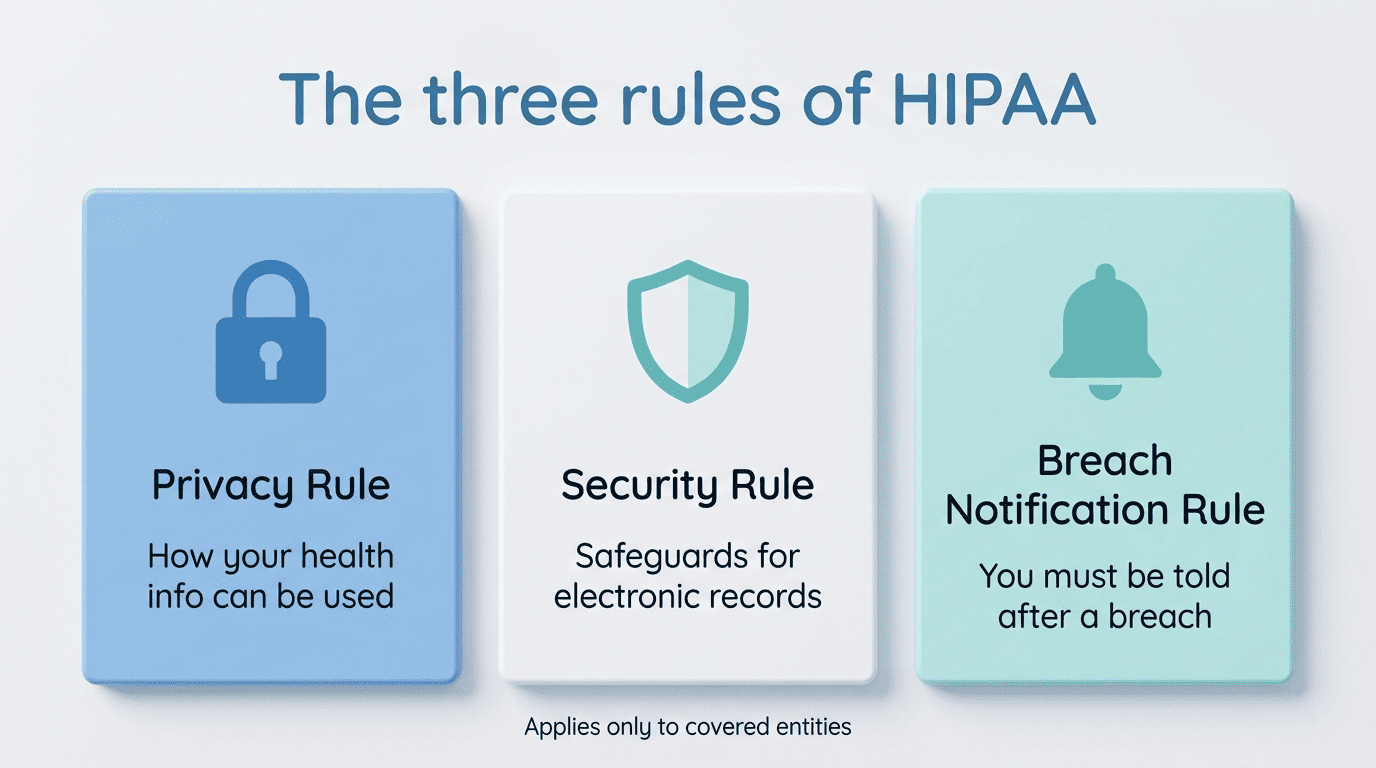
Data you volunteer to a consumer app sits outside that entire framework by default. You typed it in freely, the company isn’t a covered entity, and none of the three rules above ever engages. That gap is exactly why the FTC has started treating some health-app data practices as a deceptive-trade-practices issue instead, filling in where HIPAA doesn’t reach.
Health data that commonly falls outside HIPAA’s protection includes:
- Symptom-checker and general AI health assistant conversations
- Fitness-tracker and wearable-device data
- Direct-to-consumer genetic testing results
- Wellness-app mood, sleep, or nutrition logs
The Real Privacy Risks You Should Know
Outside HIPAA’s boundary, a smaller and less familiar set of protections applies — and the gaps are real enough to matter before you share anything sensitive. Watch for these warning signs in particular:
- A privacy policy that reserves the right to “share data with partners” without naming them
- No visible option to delete your account or chat history
- No mention of encryption standards anywhere in the app’s documentation
- Marketing language that says “HIPAA-compliant” without ever mentioning a signed BAA
Your data can be sold or shared. On the federal level, there is no blanket law banning the sale of non-HIPAA health data to third parties or data brokers. The 2023 breach and subsequent bankruptcy of the genetic-testing company 23andMe made this risk concrete: millions of users’ genetic and health data became an asset in a corporate proceeding, not a protected record shielded by HIPAA.
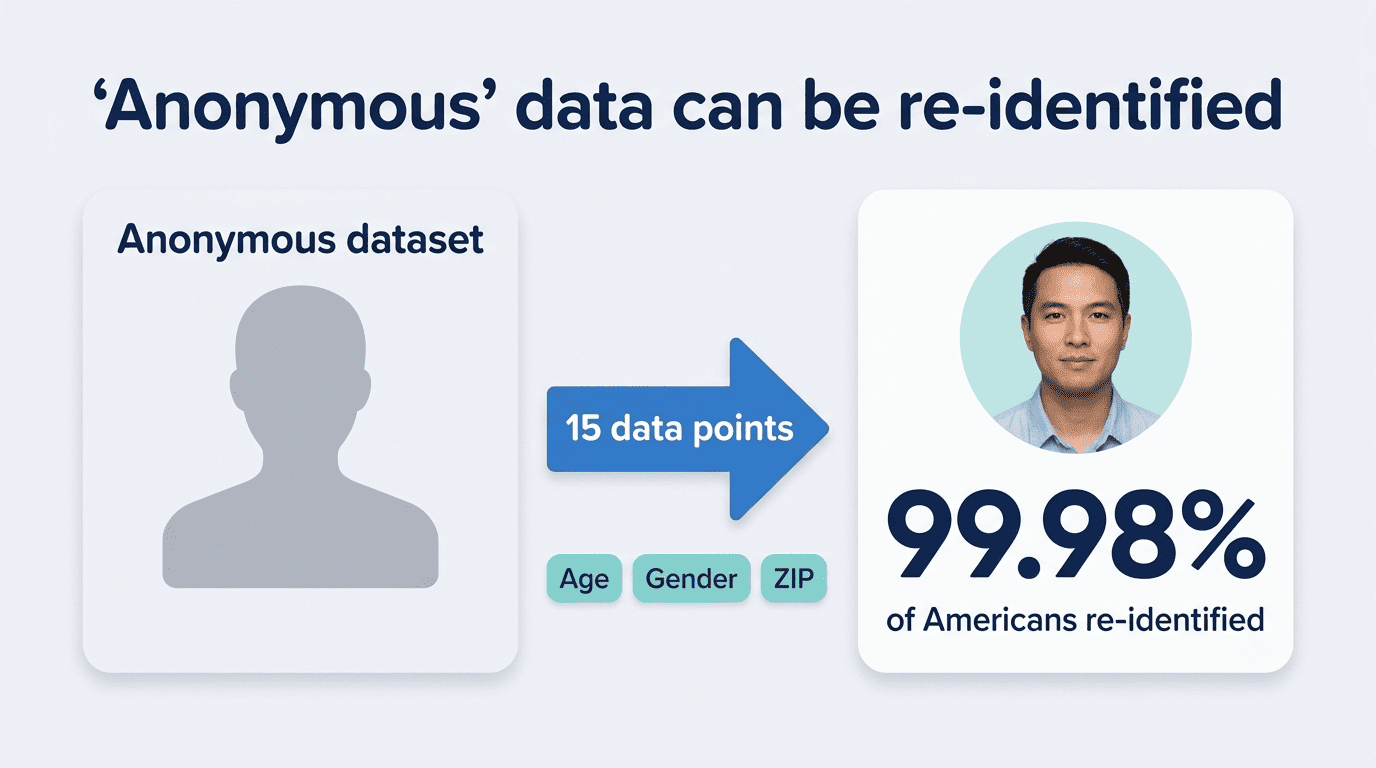
“Anonymous” isn’t always anonymous. Companies routinely describe shared or sold data as “de-identified,” but de-identification is reversible more often than people assume. A 2019 study published in Nature Communications found that just 15 demographic attributes — things like age, gender, and zip code — were enough to correctly re-identify 99.98% of Americans inside an “anonymized” dataset, a threshold most apps’ data-sharing agreements clear without much effort.
Our results suggest that even heavily sampled anonymized datasets are unlikely to satisfy the modern standards for anonymization set forth by GDPR and seriously challenge the technical and legal adequacy of the de-identification release-and-forget model.
Rocher, Hendrickx & de Montjoye, Nature Communications
Free and public chatbots may train on your input. Consumer-facing AI health tools built on general-purpose models frequently lack a business associate agreement, meaning anything typed into a free chatbot session — including many services marketed as a free AI doctor online — can be used to improve the underlying model. The FTC has warned health-app makers that data-sharing practices which contradict a privacy policy’s own promises can be treated as a deceptive trade practice — a company advertising itself as “HIPAA-compliant” without a signed BAA is making a voluntary marketing claim, not stating a legal fact.
What a Trustworthy AI Doctor Looks Like
Not every consumer AI health app treats your data the same way, and a handful of concrete signals separate the trustworthy ones from the rest.
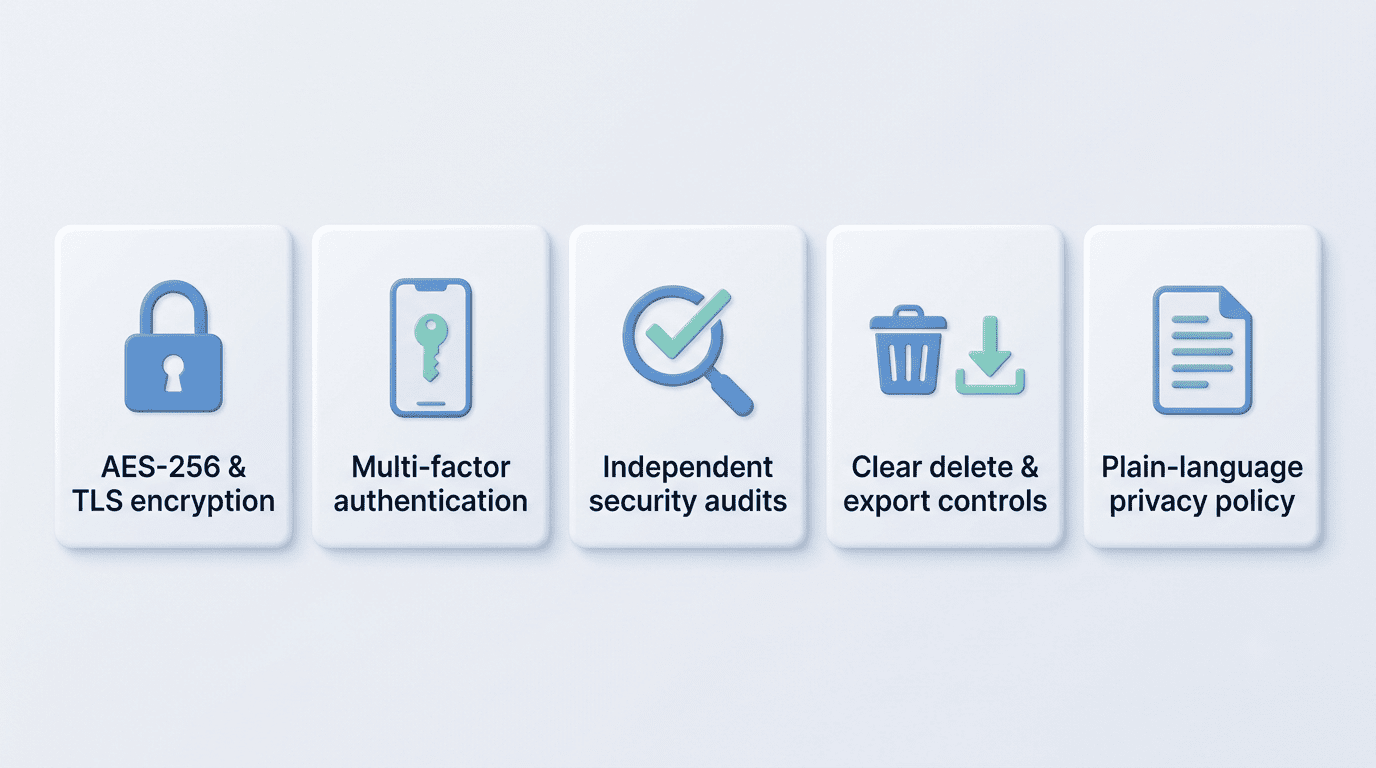
A privacy-conscious app should encrypt data with AES-256 while it’s stored and TLS (the modern successor to SSL) while it’s in transit, use multi-factor authentication and role-based access controls to limit who can see your information internally, and keep audit trails of who accessed what and when. It should write its privacy policy in plain language rather than dense legalese, give you a clear way to view, download, and delete your data, and — even without a legal HIPAA requirement — voluntarily align its practices with HIPAA-style standards and submit to independent third-party security audits. Some more advanced platforms also use techniques like federated learning or differential privacy, which are designed to extract insight from data without ever centralizing your raw, identifiable records.
| Signal to check | Why it matters |
|---|---|
| AES-256 encryption at rest, TLS in transit | Data is unreadable if intercepted or stolen |
| Multi-factor authentication (MFA) | Limits account takeover even if a password leaks |
| Independent third-party security audits | Verifies claims instead of taking them on faith |
| Clear delete/export controls | Gives you an actual exit, not just a promise |
| Plain-language privacy policy | Signals the company isn’t hiding data-sharing terms |
A free AI doctor worth trusting should be able to state, in plain terms on its own site, exactly what it collects and how you can delete it.
How to Protect Yourself When You Ask an AI Doctor
You don’t need to avoid AI health tools to stay protected — you need a short, repeatable habit before you type anything sensitive into one.
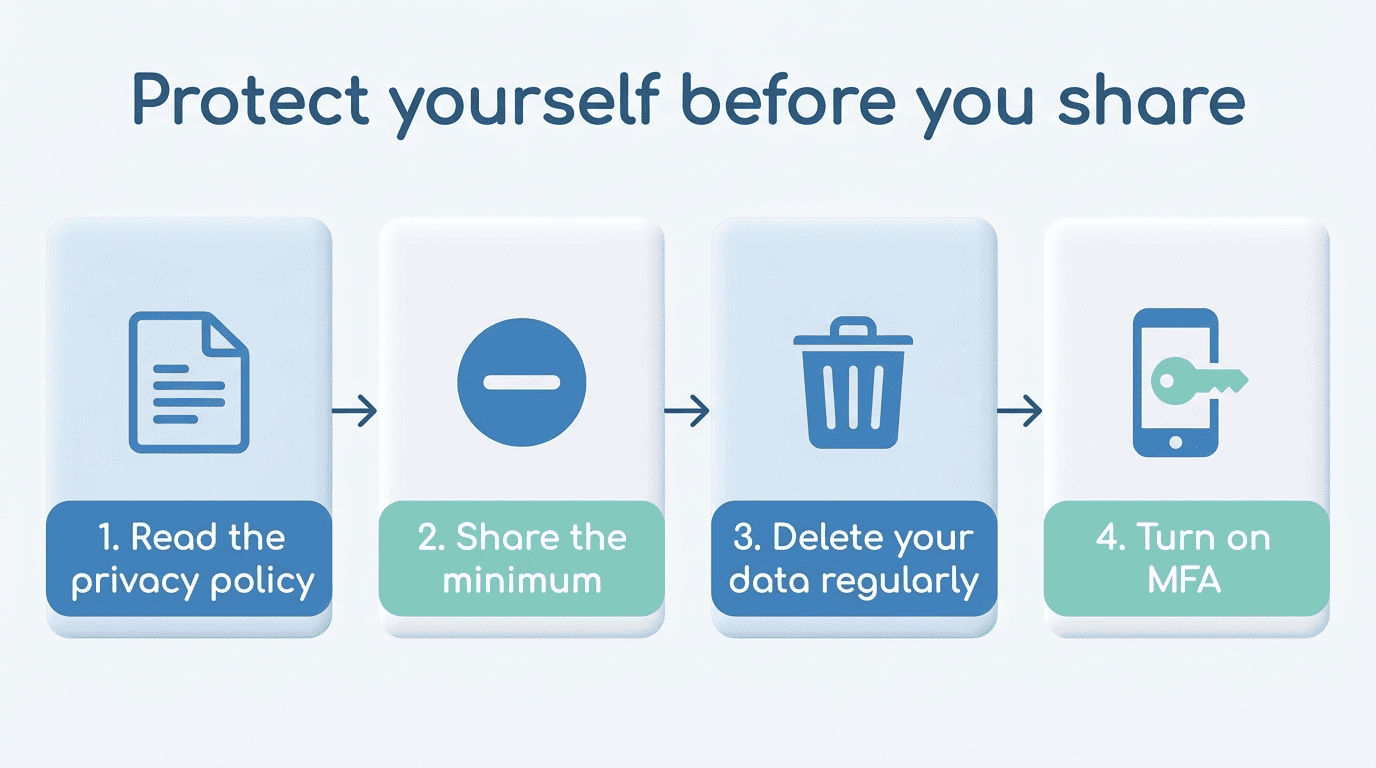
- Read the privacy policy before you share anything, specifically the section on whether data is sold or shared with third parties.
- Share the minimum information needed to get a useful answer — symptoms and context, not your full medical history.
- Avoid uploading complete medical records, imaging files, or lab reports unless the app clearly states how that data is protected.
- Turn on any available chat-deletion or data-deletion controls, and use them regularly.
- Enable multi-factor authentication on the account if the app offers it.
- Use a pseudonym or omit identifying details where the tool still works without your real name.
- Ask directly, in the app’s support channel or FAQ, whether your data is ever sold — a vague or absent answer is itself useful information.
When you ask an AI doctor a question, treat it like a conversation worth protecting — the same caution you’d bring to any account that holds sensitive information about you.
FAQ
An AI doctor is not a substitute for a licensed physician and does not provide a diagnosis. For medical emergencies call 911. Always consult a real, licensed doctor for diagnosis and treatment, and protect your data by reading the privacy policy before you share anything with an AI health app.