How Accurate Is an AI Doctor? The Honest Numbers
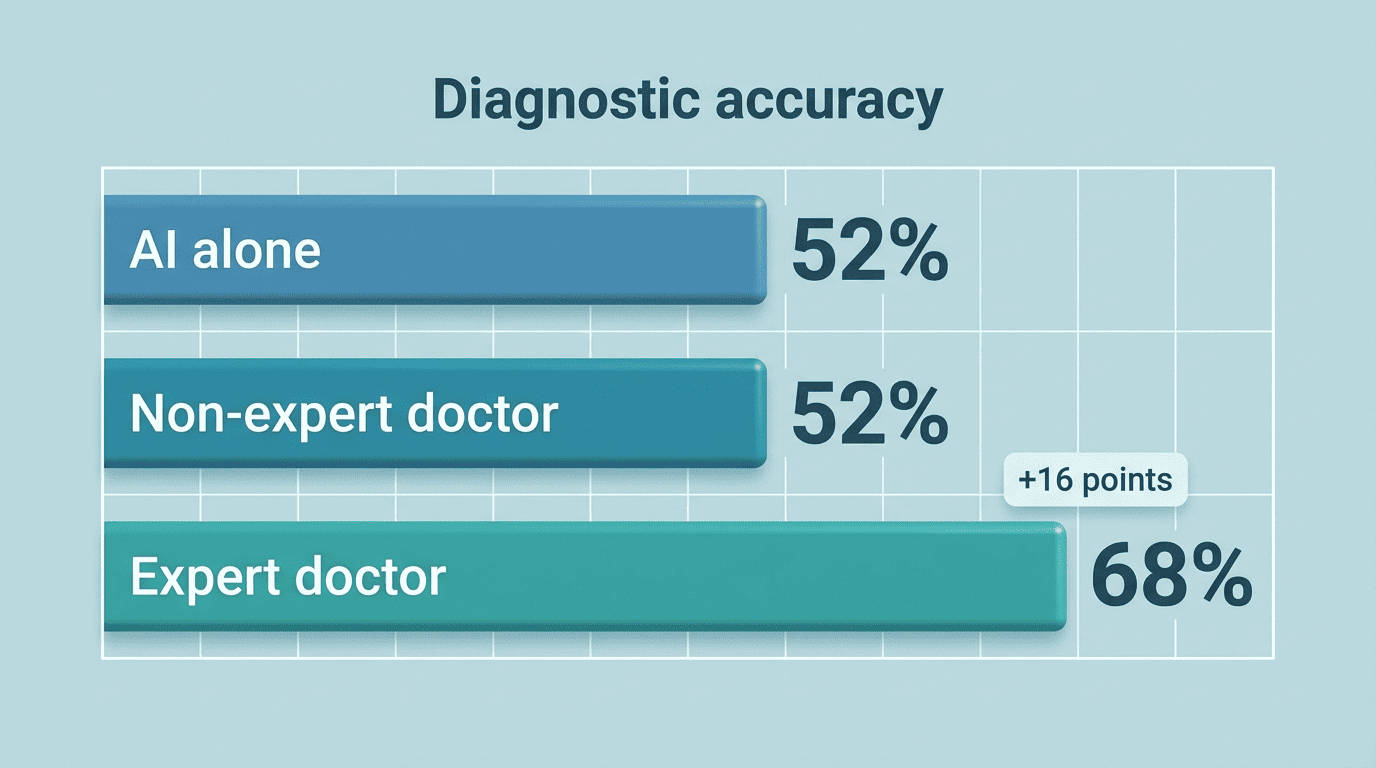
The honest answer: an AI doctor is roughly as accurate as a non-specialist physician for common problems, but it clearly trails an expert. A large 2025 meta-analysis in npj Digital Medicine put standalone generative-AI diagnostic accuracy at about 52%. An AI doctor online is best treated as a well-read second opinion, not a verdict.

An AI doctor is not a substitute for a licensed physician and does not provide a diagnosis. For medical emergencies call 911. The accuracy numbers below explain what it’s good for — and exactly where you still need a real doctor.
The Short Answer: How Accurate an AI Doctor Really Is
Strip away the marketing and the picture is simple: a generative AI diagnostic tool, used on its own, gets the right answer a little more than half the time — and that single figure hides enormous variation by task, input quality, and who it’s being compared against.
One number to anchor on: ~52%
A 2025 systematic review and meta-analysis of 83 studies, published in npj Digital Medicine, found that generative AI models reach an overall diagnostic accuracy of 52.1% (95% CI 47.0–57.1%) when working on their own. That sounds low, but it’s an average across easy and very hard cases pooled together — the context around the number matters more than the number itself.
Compared with a real doctor
The same meta-analysis found no statistically significant difference between AI and physicians overall (p=0.10), and no significant difference against non-expert or resident physicians (p=0.93). But AI performed significantly worse than expert physicians — by about 15.8 percentage points (p=0.007). In plain terms: an AI symptom checker is comparable to a generalist fresh out of training, and clearly behind a specialist with years of pattern recognition — and putting an AI doctor compared with a real doctor side by side shows that gap widening as the case gets harder.
Why the Accuracy Number Jumps Around So Much
Anyone comparing headlines will notice wildly different figures — 97% in one study, 40% in another. That spread mostly comes down to a handful of variables that rarely get mentioned in the headline itself:
- How the input was collected — a structured clinical chart versus a patient’s own words
- Whether “correct” means the single top answer or any of the top 3-5 suggestions
- How common or rare the underlying condition is
- Which model and version was tested, and when
- Whether the study measured diagnosis, triage, or both
Garbage in, garbage out: input quality is everything
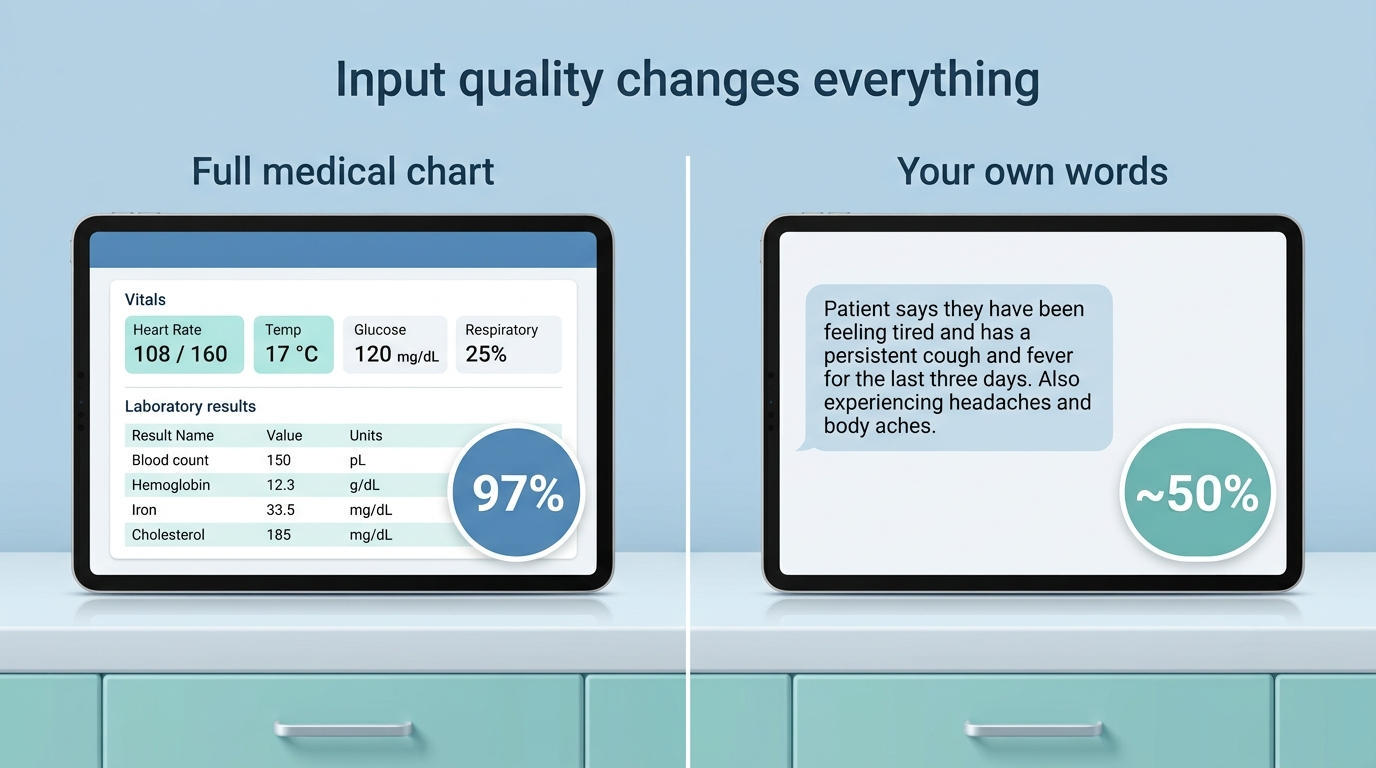
In a JMIR study of 100 emergency-department patients, ChatGPT running on GPT-4 reached 97% correct-or-partially-correct diagnoses — but only because it was fed the same physician-curated chart the treating doctors used, complete with vitals, labs, and clinical notes. Given only a patient’s raw self-reported symptoms, the same kind of model’s accuracy falls to roughly 50% for a top-3 match. The AI diagnostic tool is only as good as what you tell it, and understanding how an AI doctor works under the hood explains why the very same model can swing so far on input quality alone.
Top-1 vs top-3: which number are they quoting?
A claim of “70-80% accurate” usually means the correct answer appears somewhere in the AI triage tool’s top three suggestions, not that it named the right condition first. Ask the same system for a single answer and accuracy can drop to 34-40%. When you see an accuracy claim for any AI health assistant, check whether it’s top-1 or top-3 — they are very different promises, and vendors tend to lead with the more flattering one.
| Measurement | Typical accuracy | What it means |
|---|---|---|
| Top-1 (single best answer) | 34-40% | Correct diagnosis named first, no alternatives offered |
| Top-3 (correct answer in shortlist) | 70-80% | Right condition appears among 3 suggestions |
| Physician-curated input (full chart) | Up to 97% | Fed the same structured data a doctor uses |
| Patient self-report only | ~50% (top-3) | Fed raw, unstructured symptom descriptions |
Where an AI Doctor Is Accurate — and Where It Fails
Diagnostic accuracy isn’t one skill; it’s several, and an AI doctor is much better at some than others. Knowing which is which changes how you should actually use the tool.
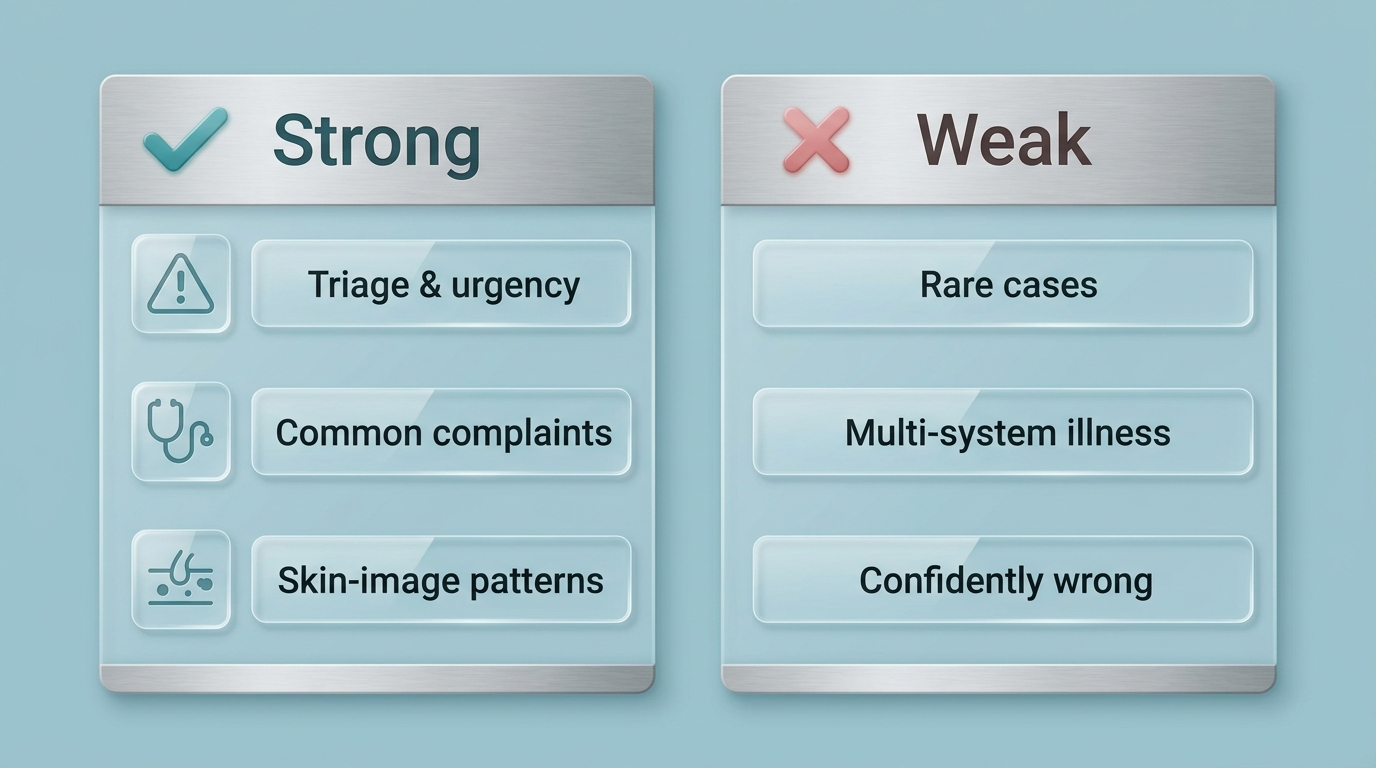
Strong at triage. An AI doctor is most reliable when the question is “how urgent is this,” not “what exactly is this.” Sorting a symptom into emergency, urgent, or routine is a narrower, better-defined task than reaching a final diagnosis, and models tend to do it more consistently.
Strong on common, well-documented complaints. Straightforward, frequently-seen problems — the kind with abundant training data and clear symptom patterns — play to a generative AI diagnosis tool’s strengths.
Strong in narrow, image-heavy specialties. In pattern-recognition tasks like dermatology, a pooled analysis of prospective melanoma-detection studies found AI alone reaching about 80.9% sensitivity and 75.6% specificity — comparable to unaided dermatologists — and climbing to roughly 91.9% sensitivity and 83.7% specificity when AI assists a dermatologist rather than replacing one. Well-defined visual pattern problems are close to the tool’s home turf.
Weak on complex, rare, or multi-system cases. Accuracy drops sharply when symptoms overlap across body systems or point to an uncommon condition — precisely where an expert physician’s judgment matters most.
Weak in a way that’s easy to miss: confident wrongness. An AI doctor can state an incorrect diagnosis in fluent, reassuring language, with no visible hedge to signal doubt. A plausible-sounding result is not the same as a correct one, which is exactly why a human check still matters.
Can You Trust the Studies? Read the Fine Print
Even the encouraging numbers above come with caveats worth knowing before you weigh them.
In the 83-study meta-analysis, 63 of 83 studies — 76% — were rated at high risk of bias, and the authors flagged statistically significant publication bias (p=0.045), meaning flattering results are likely over-represented in the published literature. The headline-grabbing 97% emergency-department result came from a single study of just 100 patients, with no pre-planned sample-size calculation to confirm the finding would hold at scale.
| Limitation | What the data shows | Why it matters |
|---|---|---|
| Risk of bias | 63 of 83 studies (76%) rated high risk | Many results may be more favorable than real-world use would produce |
| Publication bias | Statistically significant (p=0.045) | Studies with disappointing results are less likely to get published |
| Small samples | ED study based on 100 patients | No pre-planned sample size to confirm the 97% figure generalizes |
| Curated vs raw input | 97% (curated chart) vs ~50% (self-report) | The same model’s accuracy swings by roughly 47 points depending on input quality |
A few recurring gaps show up across this body of research:
- Most studies test AI against text-based vignettes, not messy real-world conversations
- Few trials measure what happens after a wrong AI answer, i.e. downstream harm
- Sample sizes are often too small to support the confidence implied by the headline number
- Independent replication outside the original research team is still rare
The authors of that meta-analysis were blunt about what their own numbers mean:
Generative AI models are not yet reliable substitutes for expert physicians but may serve as valuable aids in non-expert scenarios and as educational tools for medical trainees.
npj Digital Medicine meta-analysis, 2025
Treat headline accuracy figures as optimistic ceilings, not guarantees. A number pulled from a small, high-risk-of-bias study is not the same as a number that will hold up for your specific symptoms.
How to Use an AI Doctor Safely Given Its Accuracy
Given the numbers above, the smart move is to match the tool to what it’s actually good at rather than to what it sounds capable of.
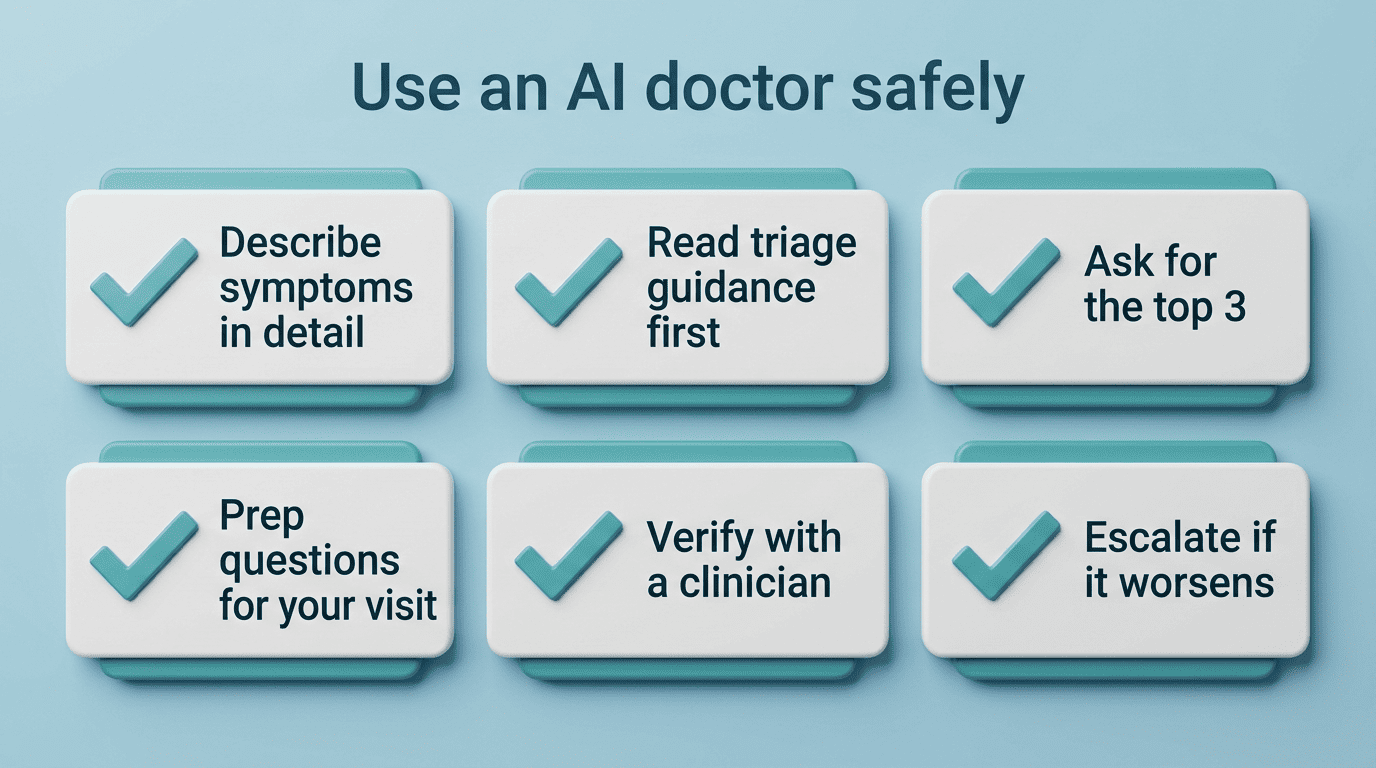
- Describe symptoms in detail, not shorthand. Accuracy depends heavily on input quality, so include duration, severity, and any changes over time.
- Read the triage guidance first. Urgency assessment is where an AI symptom checker performs most reliably — pay attention if it flags something as urgent.
- Ask for the top 3, not just the top 1. A shortlist of possibilities is more honest than a single confident-sounding answer.
- Use it to prepare questions for a real appointment. Turning vague worry into a specific list of questions is one of the tool’s most reliable uses.
- Verify anything that matters with a licensed clinician, especially for new, serious, or persistent symptoms.
- Escalate immediately if symptoms worsen — don’t wait for the AI to catch up.
- Never treat a single AI answer as final. Cross-check it against how you actually feel and against professional advice.
An AI diagnostic tool tends to be most useful for a specific set of tasks and least useful for others. Before leaning on one, it helps to know which side of that line your situation falls on:
- Understanding unfamiliar medical terms from a lab result or referral letter
- Gauging how urgent a new symptom might be
- Preparing a clear list of questions before a doctor’s visit
- Getting general health education on a condition you already have
- Deciding between a same-day visit, a scheduled appointment, or watchful waiting
The peer-reviewed consensus is blunt: generative AI is a valuable aid in non-expert scenarios, not a reliable substitute for an expert physician. The U.S. Food and Drug Administration tracks AI-enabled medical devices that are cleared for marketing precisely because unverified AI outputs carry real clinical risk — a reminder that regulators, not just researchers, treat this accuracy gap as material.
When to Skip the AI and See a Real Doctor
An AI doctor is not a substitute for a licensed physician and does not provide a diagnosis. For medical emergencies call 911.
No accuracy percentage — not 52%, not 97% under ideal conditions — makes an AI diagnostic tool safe to rely on for a serious, sudden, or worsening symptom. Skip the AI and go straight to a real doctor or emergency care for symptoms such as:
- Chest pain or pressure, or difficulty breathing
- A sudden, severe headache unlike any before it
- Uncontrolled bleeding or a rapidly worsening injury
- Signs of stroke — facial drooping, arm weakness, slurred speech
- Any symptom that simply feels like an emergency
Use an AI health assistant to inform yourself and organize your thinking, then let a licensed clinician make the actual call.