
How Does an AI Doctor Work? A Plain-English Look Inside
An AI doctor works by converting your plain-language description of symptoms into a ranked list of possible causes and an urgency recommendation, using natural language processing and machine learning trained on medical literature. If you want to try the process yourself, you can ask an AI doctor directly rather than searching through forums and outdated articles.

An AI doctor is not a substitute for a licensed physician and does not provide a diagnosis. For medical emergencies call 911. Everything below explains the mechanics, but any output should be confirmed with a real, licensed doctor before you act on it.
What an AI Doctor Actually Is
A first-opinion tool, not a diagnostician
An AI doctor is software that accepts symptoms described in everyday language and returns possible explanations along with a recommendation for how quickly you should seek care. It functions as a virtual first opinion or a clinical decision support tool — closer to an AI symptom checker or medical chatbot than to a clinician who can examine you. Demand for this kind of tool has grown fast: more than 40 million people already ask ChatGPT health-related questions every day, according to OpenAI, and roughly 79% of U.S. adults say they’re likely to search online for an answer to a health symptom or condition, according to a 2025 survey from the Annenberg Public Policy Center. An AI health assistant is built to catch that traffic and give it structure instead of a random list of search results.
Why demand is exploding
The gap an AI doctor fills is practical, not theoretical. Americans wait an average of 31 days for a new physician appointment nationally, and considerably longer for specific specialties — averaging around 40 days for gastroenterology or OB/GYN — according to a 2025 AMN Healthcare survey. Nearly half of working-age adults, 46%, said they struggled to afford healthcare for their family in 2025, according to research from the Robert Wood Johnson Foundation and the Urban Institute. Emergency departments absorb a share of that pressure they were never designed for — one national study found up to 29% of U.S. ER visits could be classified as avoidable or potentially avoidable. An AI-powered medical assistant sits in the space between “googling my symptoms” and “getting an actual appointment,” giving people a structured first read while they wait — a place to check your symptoms with an AI doctor instead of scrolling through forums.
The Technology Under the Hood
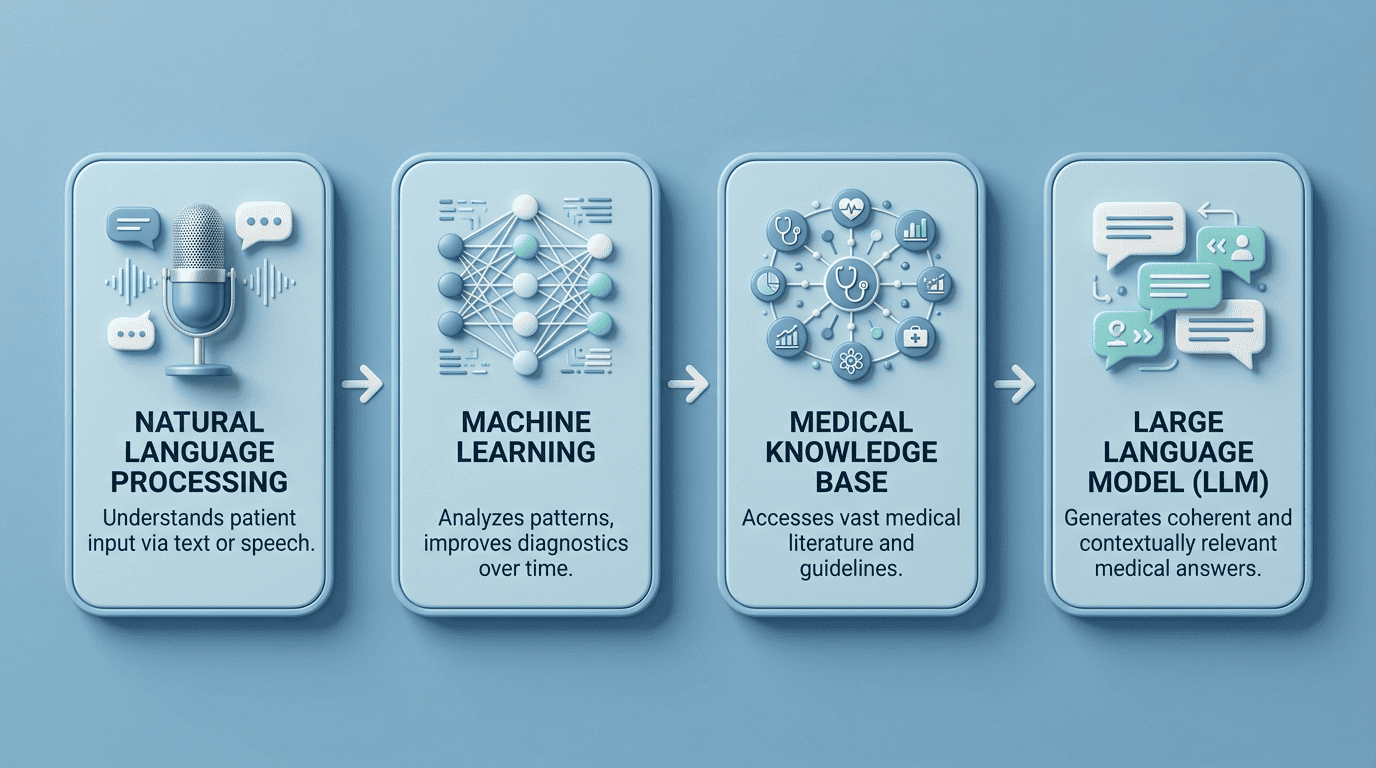
An AI doctor is not one algorithm — it’s a stack of several technologies working together, each handling a different part of the problem:
- Natural Language Processing to read and structure what you type
- Machine Learning trained on medical literature and records to spot patterns
- A medical knowledge base or knowledge graph linking symptoms to conditions
- A Large Language Model layer that adds conversational reasoning on top
Natural language processing (NLP)
Natural Language Processing is what lets the system understand a sentence like “I have a runny nose and my throat hurts” the way a triage nurse would. NLP extracts the individual symptoms, their duration, and their severity from ordinary conversational text, then converts that loose description into structured medical concepts the rest of the system can work with.
Machine learning trained on medical data
Machine Learning models are trained on millions of medical journal articles, clinical guidelines, treatment protocols, and de-identified patient records, sometimes drawn from Electronic Health Records (EHR). Training on that volume of data lets the model find statistical patterns linking symptoms, demographics, and risk factors to specific conditions — the same kind of pattern-matching a physician builds through years of seeing patients, compressed into a model.
The medical knowledge base and knowledge graph
Underneath the conversation sits a medical knowledge base: a structured graph connecting symptoms to conditions, risk factors, and recommended next steps. Earlier-generation AI symptom checkers relied mainly on decision trees or Bayesian networks — rule-based statistical models that calculate the probability of each condition given a set of symptoms. The newest generation adds a Large Language Model layer on top of that structured base (tools like DxGPT are one example), while deep neural networks analyze clusters of symptoms that simpler rule-based models tend to miss.
Step by Step: What Happens When You Describe Symptoms
Every AI doctor interaction follows roughly the same sequence, whether the interface is a chat window or a structured questionnaire.
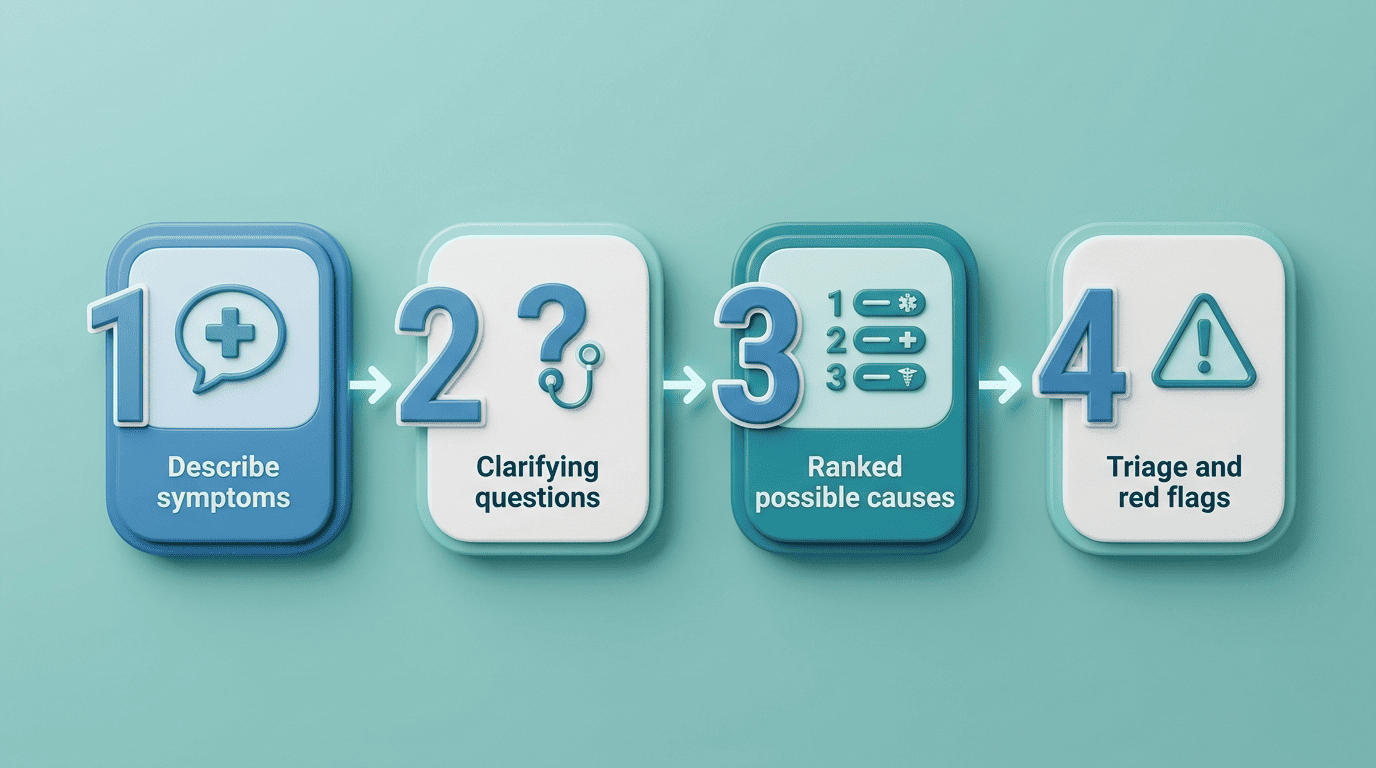
- You describe your symptoms. Free text or a guided Q&A captures your History of Present Illness (HPI) — what you’re feeling, where, how long it’s lasted, and how severe it is.
- The system asks clarifying questions. Much like a physician during an intake, the AI doctor follows up to narrow down ambiguous or overlapping symptoms.
- It produces a differential diagnosis ranked by likelihood. Your inputs are matched against the knowledge base to generate a list of possible causes ordered by probability — a typical output might read something like 40% viral infection, 30% food poisoning, and 5% something more serious.
- It performs triage and red-flag detection. The system assigns an urgency level — self-care, see a doctor within 24 hours, or seek emergency care — and a separate detection layer scans for red flags such as chest pain or stroke symptoms, which route you straight to 911 or the nearest emergency room.
If any red flags appear in that last step, the appropriate response is always the same: stop scrolling and get emergency help immediately. Red-flag detection is a deliberately conservative layer — it’s tuned to over-trigger rather than miss something dangerous, because the cost of a false alarm is far lower than the cost of a missed emergency. The symptoms below are the kind that consistently trigger that layer:
- Sudden chest pain or pressure
- Signs of stroke — face drooping, arm weakness, slurred speech
- Severe or uncontrolled bleeding
- Trouble breathing
- Sudden, severe, or rapidly worsening symptoms
How Accurate Is an AI Doctor?
What the studies show
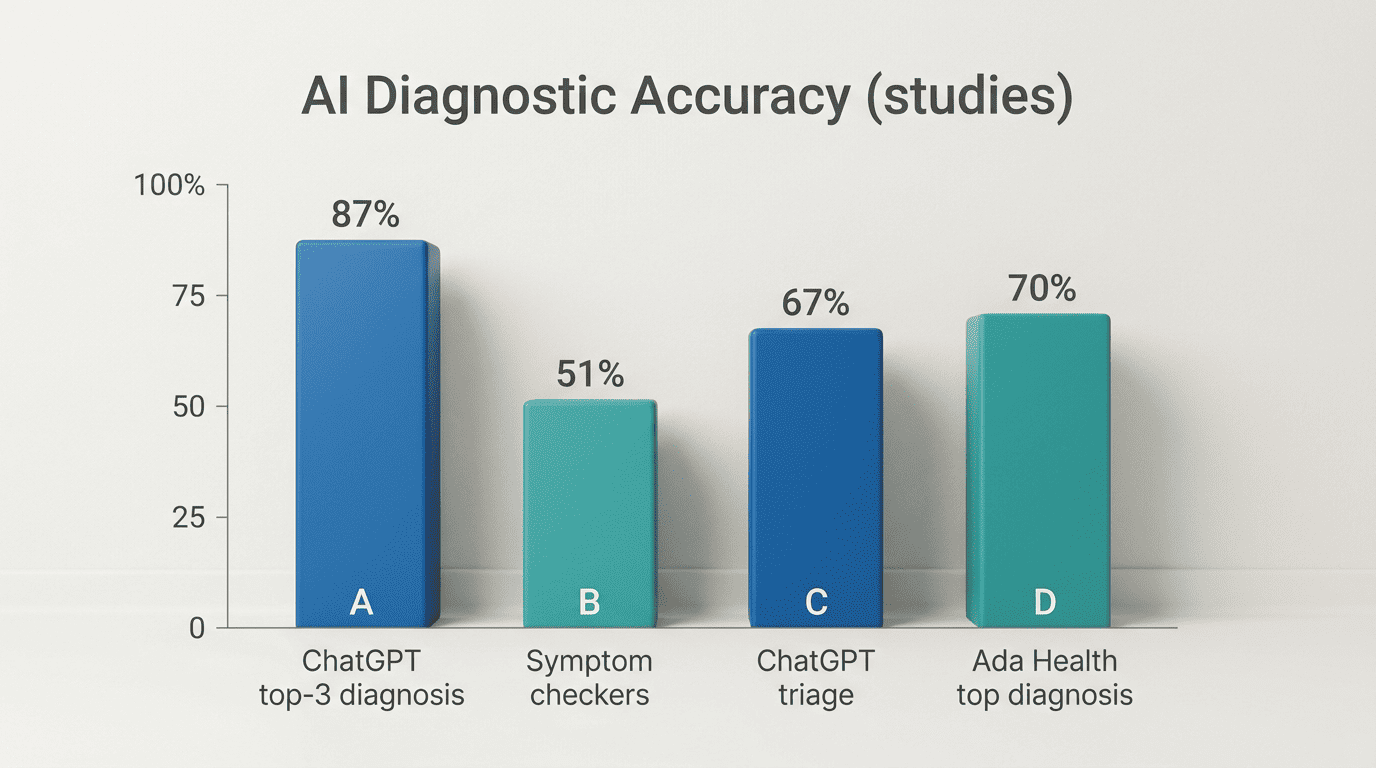
The question of how accurate an AI doctor really is has no single answer — accuracy numbers vary by study and by task, but the pattern is consistent: general-purpose AI is getting good at narrow diagnostic questions while still falling short of a full clinical evaluation. For context, patient-safety research has repeatedly put the overall physician diagnostic error rate at roughly 10–15% across care settings, so no comparison here is against a perfect baseline.
| System | Metric | Result |
|---|---|---|
| ChatGPT | Correct diagnosis in top 3 suggestions | 87% |
| Traditional AI symptom checkers | Correct diagnosis in top 3 suggestions | 51% |
| ChatGPT | Correct triage recommendation | 67% |
| Ada Health vs. rheumatologists | Top-diagnosis accuracy | 70% vs. 54% |
| AI symptom checker users (Isabel Symptom Checker survey) | Found the tool useful | 84.1% |
| AI symptom checker users (Isabel Symptom Checker survey) | Would use it again | 91.4% |
Where it fails — hallucinations and bias
The same technology that produces confident, well-formatted answers can also produce confidently wrong ones. In one 2024 study, researchers tested six leading large language models with clinical vignettes that each contained a single planted false detail — a fake lab value or symptom — and found the models repeated or built on that fabricated detail in up to 83% of cases instead of catching the error. This is the phenomenon known as hallucination — an answer that reads as authoritative but isn’t grounded in fact — and it’s compounded by bias baked into the training data itself, since a model can only be as balanced as the records it learned from.
Physicians who use AI will replace those who don’t.
Jesse M. Ehrenfeld, MD, President, American Medical Association
That statement is about augmentation, not autonomy — the AMA’s own guidance frames AI strictly as a tool physicians use, never as a replacement for their judgment.
What an AI Doctor Cannot Do
It cannot perform a physical examination. An AI doctor never palpates an abdomen, listens to a heartbeat, checks reflexes, or notices the nonverbal cues a physician picks up on just by watching how a patient moves. It cannot order lab work or imaging on its own, and correlation between symptoms and a condition is not the same thing as a diagnosis.
It cannot legally provide a diagnosis or prescribe treatment. Diagnosing a condition and writing a prescription are functions reserved for a licensed physician, both medically and legally. Whatever list of possibilities an AI doctor produces, it remains informational — the final call, and the responsibility that comes with it, stays with a human clinician.
In practice, that means an AI doctor cannot:
- Touch, palpate, or physically examine you
- Order lab work, imaging, or diagnostic tests
- Write or approve a prescription
- Issue a legally recognized diagnosis
- Carry medical-legal accountability for a decision
Why human oversight stays essential
Physician use of AI tools jumped from 38% in 2023 to 66% in 2024, according to an American Medical Association survey — a sharp rise, but one that reflects doctors adopting AI as an assistant, not stepping back from decisions. Human physician oversight is what turns a probability-ranked list into an actual course of treatment.
AI Doctor vs Human Doctor: Assist, Not Replace
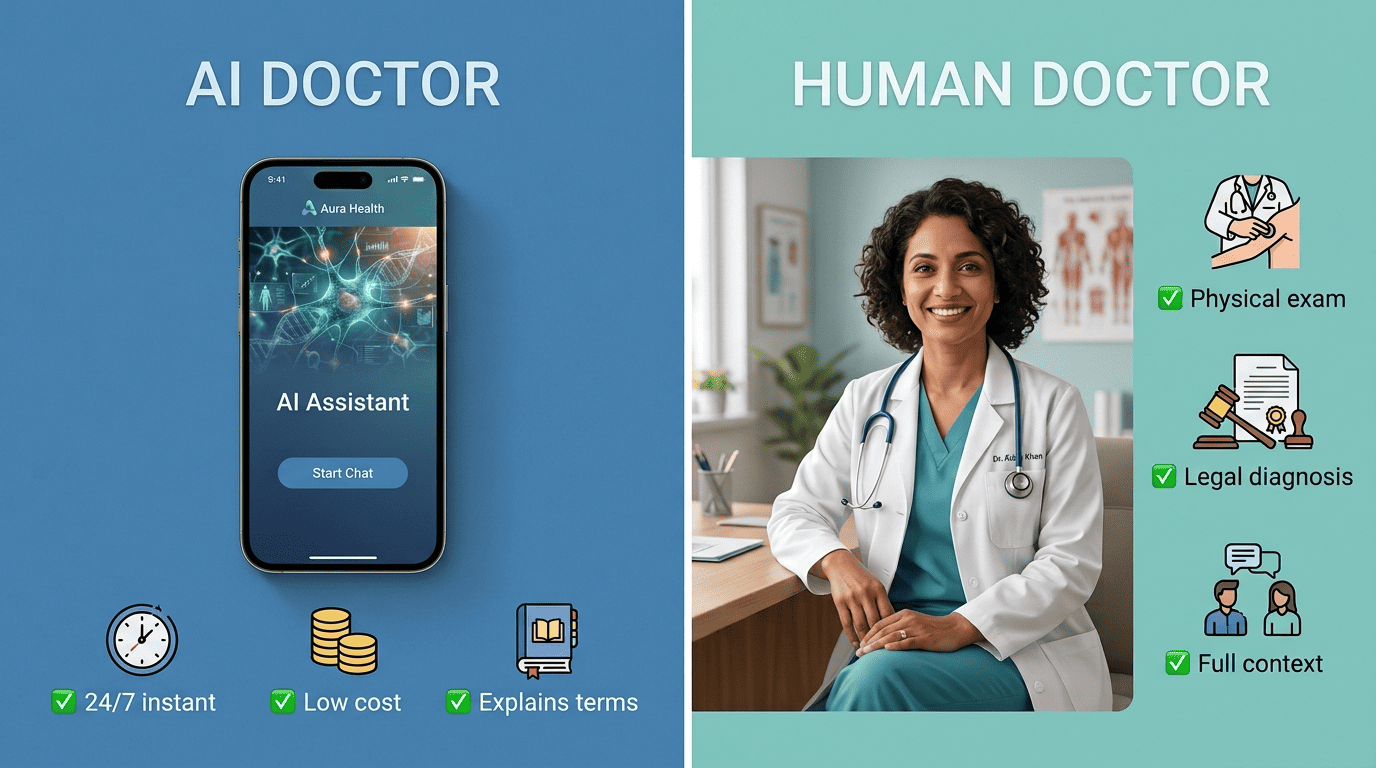
An AI doctor’s strengths are speed, 24/7 availability, and the patience to explain a medical term as many times as you need it explained. It handles routine triage questions well and never rushes you out the door at the end of a fifteen-minute slot. A human physician’s strengths sit exactly where the technology stops: a hands-on exam, the full context of your medical history, and legal accountability for the decision made. The workable model isn’t AI instead of a doctor — it’s AI doctor online as the first step, with a licensed physician making the actual decision. Used that way, an AI doctor online becomes a way to arrive at your appointment already informed, rather than a way to skip the appointment altogether.
| Strength | AI doctor | Human doctor |
|---|---|---|
| Availability | 24/7, instant | Limited by appointment slots |
| Cost per interaction | Low or free | Full consultation fee |
| Physical examination | Not possible | Yes |
| Legal diagnosis / prescription | Not possible | Yes |
| Explaining terms patiently | Strong | Time-limited |
| Weighing full patient history and context | Limited to what you type | Strong |
How to Use an AI Doctor Safely
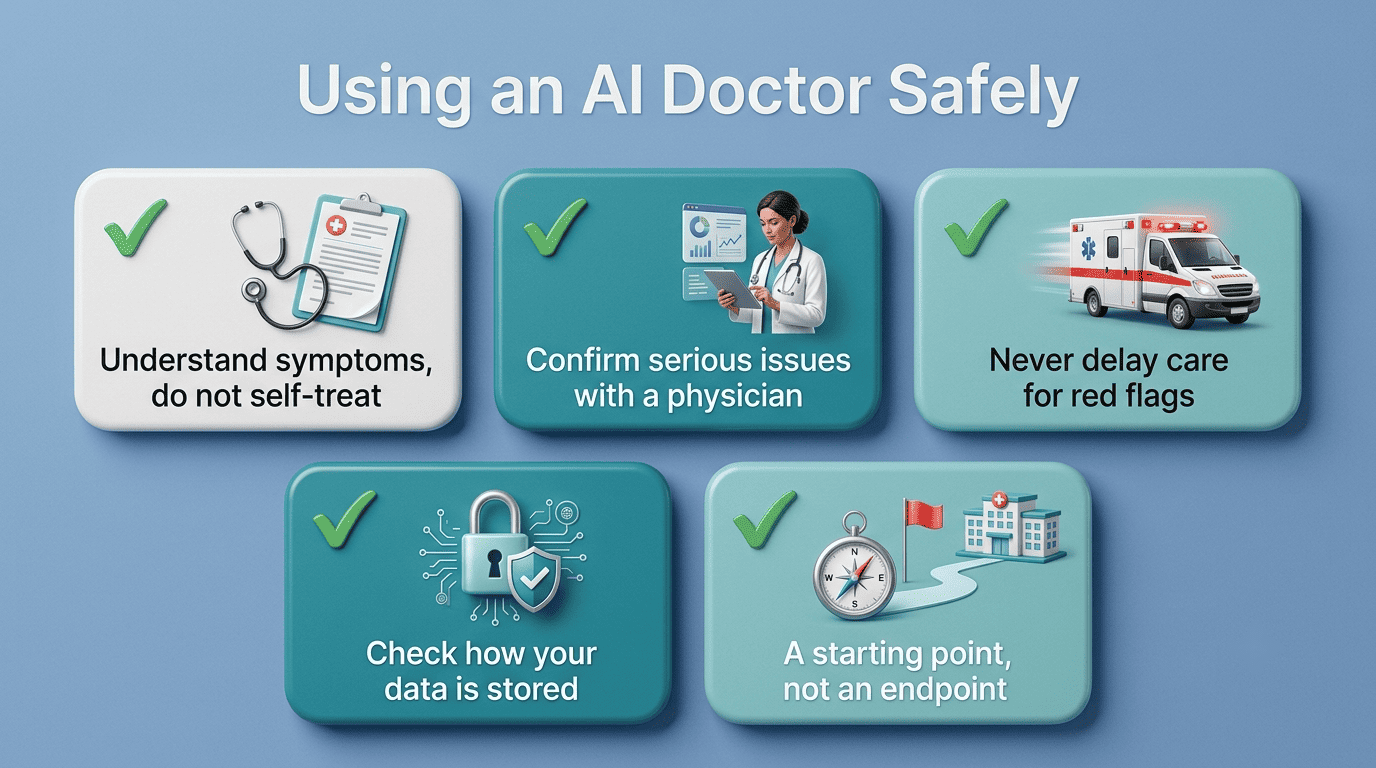
Getting value out of an AI symptom checker without taking on unnecessary risk comes down to a short list of habits:
- Use it to understand symptoms and prepare questions for your doctor, not to self-treat
- Always confirm anything serious with a licensed physician before acting on it
- Never delay care for red-flag symptoms while waiting on an AI response
- Check how the platform handles and stores your health data before sharing sensitive details
- Treat every ranked list of possibilities as a starting point for a conversation, not an endpoint
An AI doctor is not a substitute for a licensed physician and does not provide a diagnosis. For medical emergencies call 911. Keep a real doctor in the loop for anything beyond general information.