
Ask an AI Doctor About Your Medication: What It Can (and Can’t) Tell You
Millions of people now type their pill questions into a chat window instead of guessing alone or scrolling through forums at midnight. A well-built AI doctor is genuinely useful here — it can explain what a medication is for, walk through common side effects, and flag interactions with your other drugs — but it does not diagnose you, and it does not decide what you should take.
This guide draws a clear line: what to ask a virtual AI doctor about your prescriptions, what to leave for a licensed clinician, and how to check any AI answer before you act on it.
Safety note: An AI doctor is not a substitute for a licensed physician and does not provide a diagnosis. For medical emergencies call 911. Always confirm any medication decision with your doctor or pharmacist before acting on it.
What medication questions can an AI doctor actually answer?
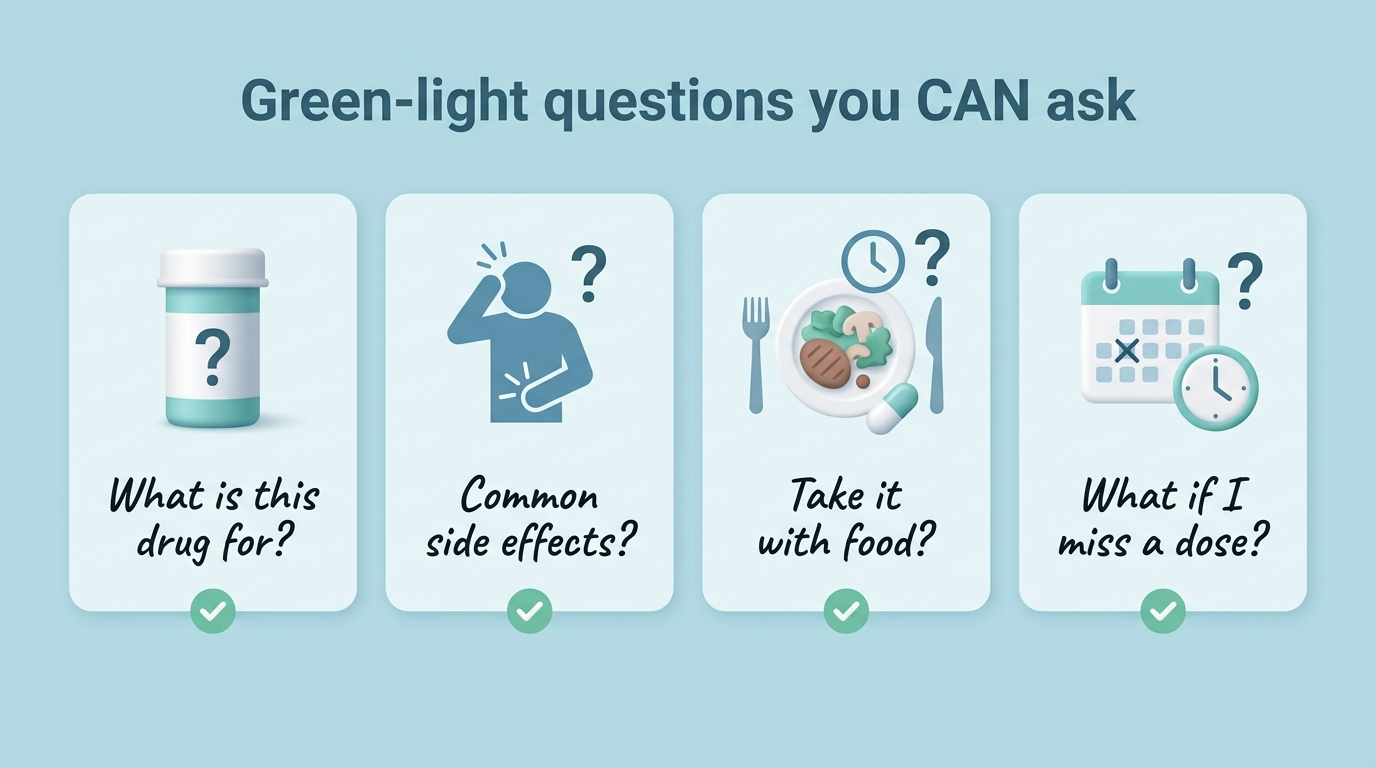
Most day-to-day medication confusion is informational, not diagnostic — and that’s exactly the territory where an AI health assistant performs well. Harvard Health has described this using a stoplight framework: questions that help you understand general information, like “what does this drug do” or “what does this test result mean,” fall into the green-light zone, meaning they’re generally safe to explore with a chatbot. Tools built specifically for this — including consumer platforms like Counsel, Docus, and vHospital — lean into that lane deliberately, positioning themselves as explainers rather than decision-makers.

Understanding what a drug is for and how it works
A personal AI doctor can name the drug class, describe the mechanism in plain language, and explain why a physician typically prescribes it for a given condition — the same plain-language skill it uses to explain what your diagnosis means. Instead of “an ACE inhibitor,” you get an explanation of how the drug relaxes blood vessels to lower blood pressure, and why that matters for your specific situation. This kind of general information is the green-light category Harvard describes — safe territory because it isn’t steering a treatment choice.
Common side effects and what to expect
Ask what side effects are common, which ones are rare but serious, and when a symptom should trigger a call to your doctor rather than a wait-and-see approach. A good AI medical assistant will separate “expected and usually harmless” from “call your doctor now.” A useful way to phrase it: “What side effects of [drug name] are common, and which ones mean I should call my doctor immediately?” Green-light examples worth asking include:
- “What is [drug name] used for, and how does it work?”
- “What are the most common side effects, and how long do they usually last?”
- “What does this line in my discharge notes mean?”
- “Is it normal to feel drowsy on this dose?”
- “What does the FDA label say about taking this with food?”
Timing, food, alcohol and missed doses
General administration rules — take with food, avoid alcohol, what to do if you miss a dose — come straight from FDA drug label data and are fair game to ask. One frequently cited example: grapefruit interacts with certain statins by blocking an enzyme that breaks the drug down, raising blood levels and the risk of muscle pain or damage, a warning tracked by resources like Drugs.com. These are pattern-level facts, not judgments about your individual treatment plan.
What you should NOT ask an AI doctor about your medication
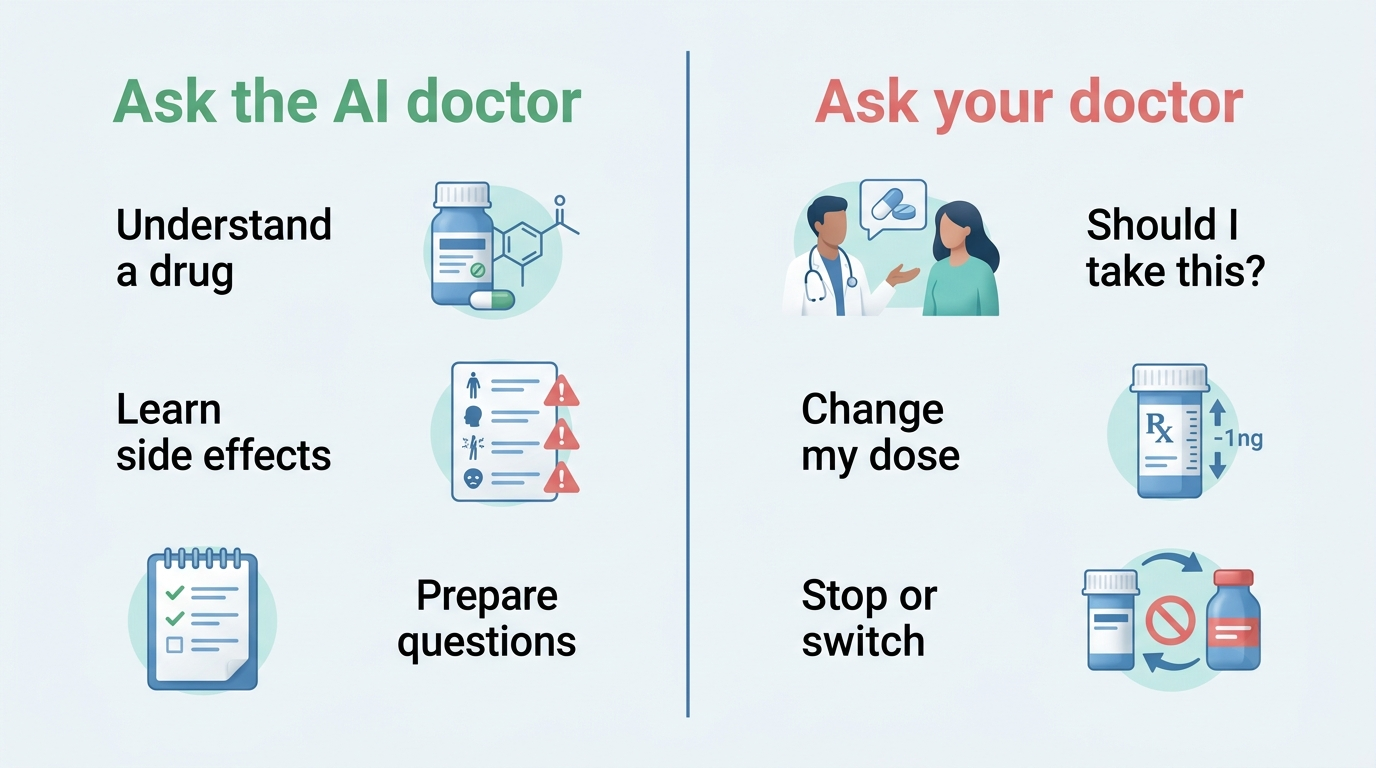
Not every medication question belongs in a chat window. Harvard Health’s framework also defines a red-light zone: questions like “Should I take this medication?” or “Is this the right treatment for me?” fall squarely into decisions that require a clinician who knows your full history, not a language model working from a text prompt. Harvard’s guidance on these is blunt — “just don’t do it.”
Red-light questions: dose changes and stopping meds
Do not ask an AI doctor whether you still need a medication, whether it’s safe to stop taking it, or whether you should double a dose. These are treatment decisions, and treatment decisions require a clinician who can weigh your labs, history, and other prescriptions together — something a chatbot session cannot replicate. Red-light phrasing to avoid includes:
- “Should I stop taking this medication?”
- “Is this the right treatment for my condition?”
- “Can I double my dose to feel better faster?”
- “Should I switch to a different drug on my own?”
Why “the AI agreed with me” is a trap
Large language models tend toward sycophancy — a documented tendency to agree with what a user seems to want to hear rather than push back with an inconvenient truth. If you ask “I think I can skip this dose today, right?” leading language, the model may validate the framing instead of correcting it. An AI agreeing with your instinct is not evidence that the instinct is medically sound, and it should never be the deciding factor in a medication change.
Can an AI doctor prescribe or refill your medication?
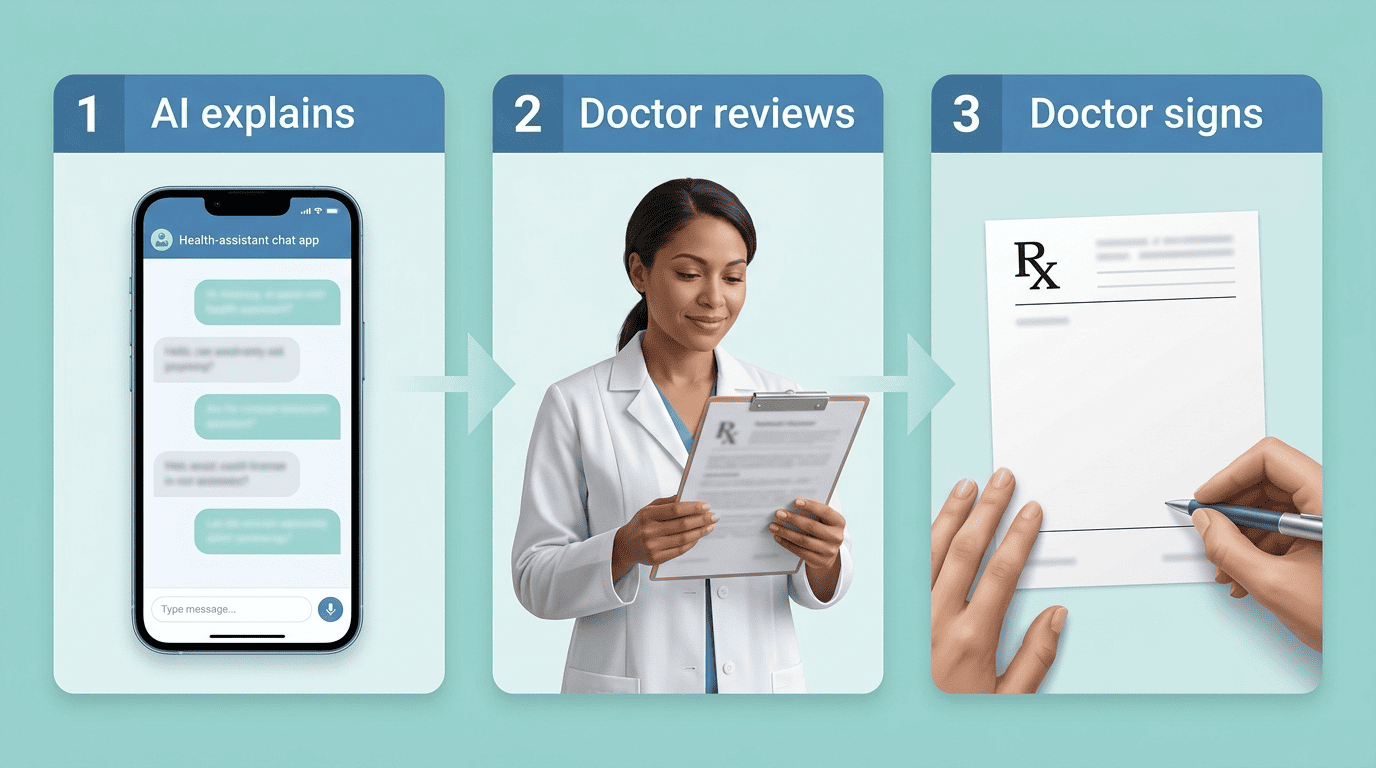
Almost never, and only under a narrow regulatory exception. An AI system cannot hold a medical license, and prescribing authority in the United States is tied to a licensed clinician’s legal accountability — something a language model, by definition, cannot carry on its own. The one notable exception is Doctronic, which became the first AI system authorized to autonomously renew prescriptions for certain chronic medications, operating inside Utah’s regulated AI sandbox rather than under ordinary practice rules. Outside that kind of tightly scoped program, an AI doctor prepares and informs; a licensed human signs off. Controlled substances raise the bar further, requiring DEA registration that only applies to human prescribers.
The legal line: no license, no prescription
An AI doctor cannot independently write or refill a prescription because prescribing requires a medical license, and licenses are issued to individuals who are legally accountable for the decision. That accountability gap is the reason no AI health assistant, however capable, can substitute for the licensed physician or pharmacist step. Controlled substances — opioids, benzodiazepines, stimulants — add another layer: dispensing them requires DEA registration, a requirement that applies only to human prescribers.
Where a human doctor steps in
Some telehealth platforms use AI to draft a prescription recommendation based on the intake conversation, but a licensed clinician reviews and co-signs it before it becomes valid — usually within the same visit. The AI speeds up the paperwork; the human signature is what makes it a real prescription.
Here’s a quick way to check whether a question belongs to the AI or to your prescriber:
| Question type | Ask the AI doctor | Ask your physician/pharmacist |
|---|---|---|
| “What is this drug for?” | Yes | Optional |
| “What side effects are common?” | Yes | Optional |
| “Should I stop taking this?” | No | Yes |
| “Can you refill my prescription?” | No | Yes |
| “Does this interact with my other meds?” | Yes (as a first screen) | Yes (to confirm) |
| “Should I double my dose?” | No | Yes |
How an AI drug interaction checker works
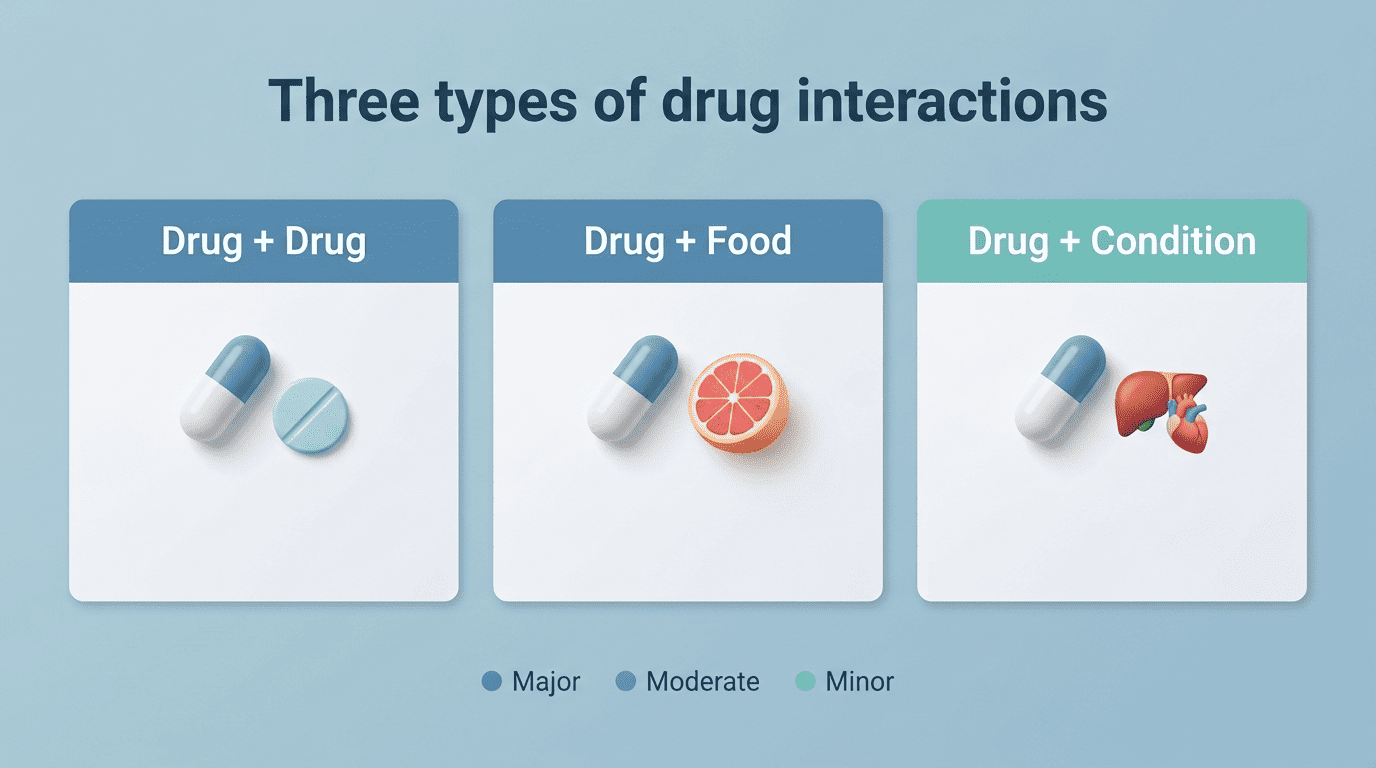
An AI drug interaction checker typically cross-references the medications you list against FDA drug label data, checking for known combinations flagged as risky. Most tools, including the Drugs.com interaction checker, let you enter multiple medications at once and return results across three categories: drug-drug, drug-food or drug-alcohol, and drug-disease interactions, usually ranked by severity as Major, Moderate, or Minor.
Drug-drug, drug-food and drug-disease
A drug-drug example: combining alcohol with opioids can compound central nervous system depression and slow breathing to a dangerous degree. A drug-disease example: acetaminophen taken by someone with significant liver disease carries elevated toxicity risk, since the liver is already compromised in processing it. Severity labels help you triage — a Major flag deserves a call to your pharmacist before your next dose, while a Minor flag might just be worth a mention at your next appointment.
| Severity | What it means | What to do |
|---|---|---|
| Major | Serious, potentially dangerous combination | Call your pharmacist or doctor before your next dose |
| Moderate | Usually manageable, may need monitoring or timing changes | Mention it at your next appointment |
| Minor | Low clinical significance for most people | Note it, no urgent action needed |
Where interaction checkers fall short
Polypharmacy — taking multiple medications simultaneously — is a real and measurable risk, particularly for older adults. A systematic review and meta-analysis of hospital admission data found that drug-drug interactions were implicated in roughly 22% of hospital admissions caused by adverse drug reactions, and older adults — who take the most medications — bear a disproportionate share of these events. Interaction checkers also have real gaps:
- Weak coverage of herbal products and supplements, which are not FDA-regulated the way prescription drugs are
- Roughly three in four U.S. adults report taking some form of dietary supplement, and many never mention this to their prescriber
- Older checkers may lag behind the newest FDA label updates
- None of them account for your individual labs, kidney or liver function, or full medical history
An AI drug interaction checker is a useful first screen, not a complete safety net.
How to ask good medication questions — and verify the answer
Getting a useful answer from a personal AI doctor is partly about how you frame the question, and partly about what you do with the answer afterward.
Give the AI the right context
Name the medication and dose, why you’re taking it, and any other drugs or supplements you’re on — the more complete the picture, the more relevant the answer. Harvard Health’s guidance also recommends stripping out personal identifiers when possible, since these tools are not a substitute for the confidentiality protections of a clinical record. A vague prompt gets a generic answer; a specific one gets something you can actually use to prepare for your doctor visit.
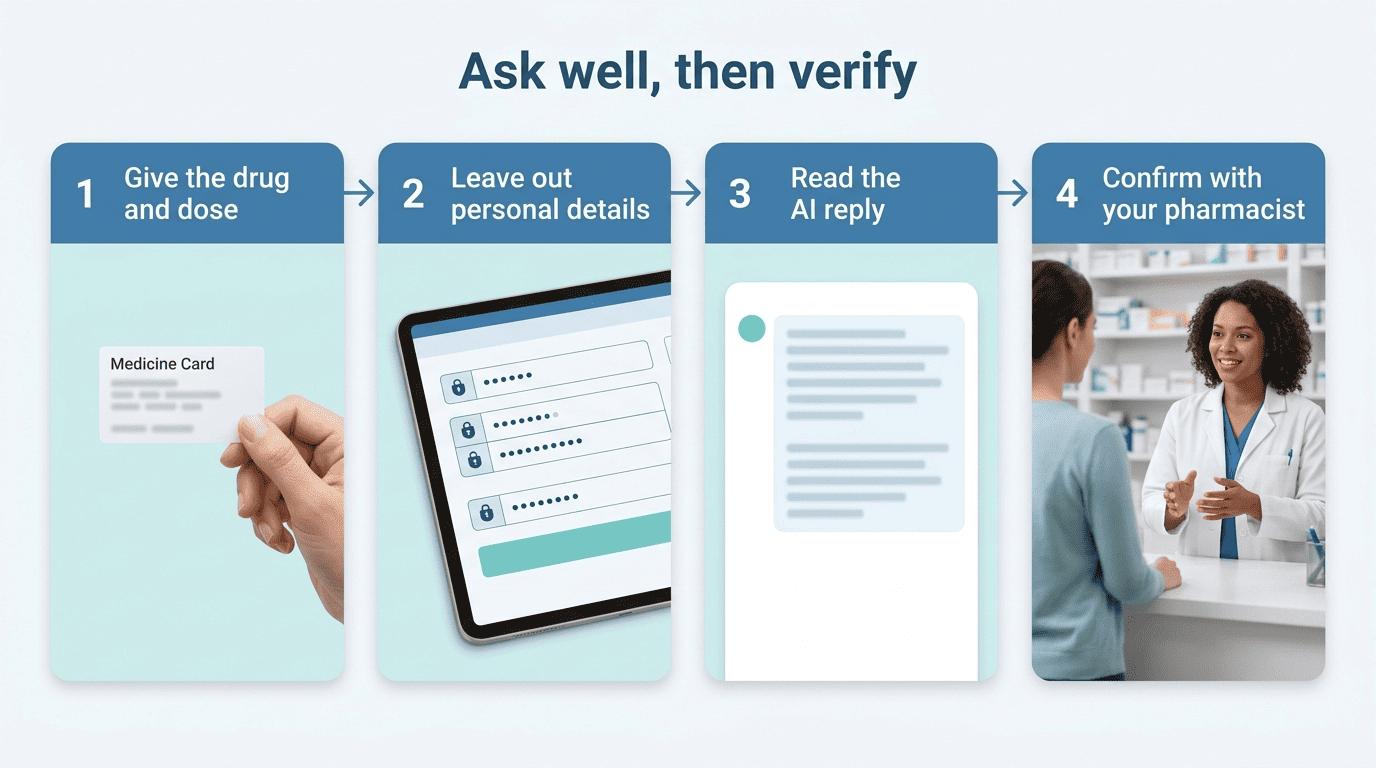
Here’s a simple way to structure that conversation before you rely on any answer:
- State the medication name, dose, and how long you’ve been taking it.
- List every other medication and supplement you currently use.
- Describe the specific concern — a new symptom, a missed dose, a planned change.
- Ask the AI to explain what’s known and what it can’t determine from the information given.
- Write down any question the AI flags as needing a clinician.
- Bring that list to your pharmacist or doctor before changing anything.
- Confirm the final decision with them, not with the chat log.
Always confirm with a pharmacist or doctor
Treat the AI’s answer as a well-organized draft, not a final word. Pharmacists typically review medication questions for free at the counter and are one of the most underused resources for exactly this kind of check. Before you start, stop, or change any medication, run the plan past a real doctor or pharmacist — a step that has nothing to do with how confident the AI sounded.
As Harvard Health puts it when weighing these tools against a clinical visit:
AI chatbots are good for some medical queries, but not for others.
Dr. Adam Rodman, Harvard Health
That distinction — information versus decision — is the one worth remembering every time you open a chat window about a prescription.
FAQ
A final word on safety: An AI doctor is not a substitute for a licensed physician and does not provide a diagnosis. For medical emergencies call 911. Use an AI health assistant to understand and prepare — then consult a real doctor or pharmacist before starting, stopping, or changing any medication.