
Can an AI Doctor Explain Your Diagnosis? What It Can and Can’t Do
Yes — an AI doctor can explain your diagnosis and lab results in plain language, but it cannot make or confirm the diagnosis itself. If you want to try the process yourself, you can ask an AI doctor to translate medical jargon, tell you what a term or lab value means, and help you prepare questions for your next appointment. A licensed physician still owns the diagnosis, not the AI.

An AI doctor is not a substitute for a licensed physician and does not provide a diagnosis. For medical emergencies call 911. Think of it as a translator for your medical results, not the doctor who diagnoses you.
Explain vs. Diagnose: The Line That Matters Most
The single most useful distinction in this whole topic is the gap between explaining and diagnosing. An AI health assistant is built to do the first; it is explicitly not built to do the second, and the tools that get this right say so out loud rather than burying it in a disclaimer nobody reads.
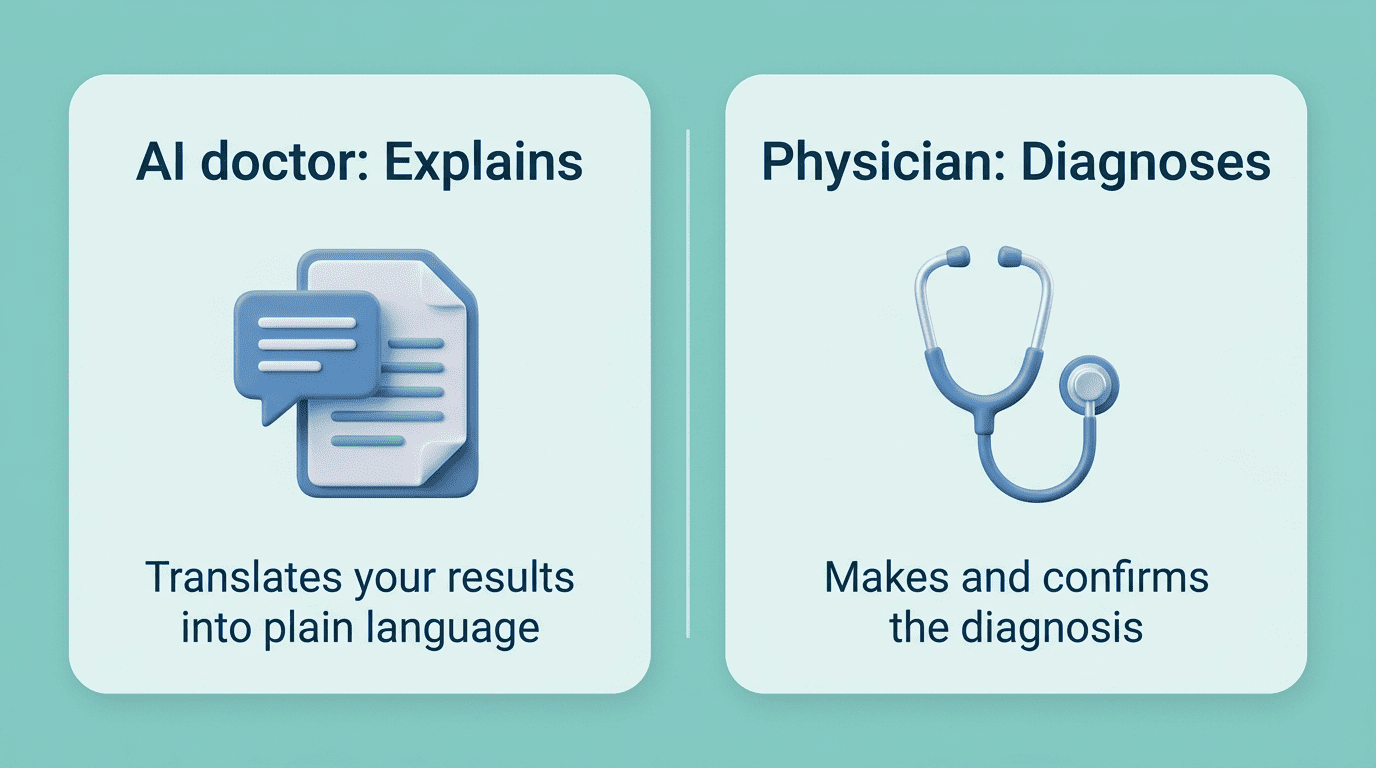
What “explain” means
Explaining means turning “your HbA1c is 6.4% and your ALT is elevated” into plain English you can actually understand, and telling you which values are out of range and why they matter. Quest’s AI Companion, a Google AI-powered chatbot, does exactly this: it summarizes completed results, explains a test’s purpose, and answers follow-up questions — available to anyone 18 and older, 24/7, across up to 20 completed results if they’re less than five years old.
A plain-language explanation from an AI health assistant typically covers a few consistent things:
- What the test was designed to measure, in everyday terms
- Whether each value sits inside, above, or below the normal reference range
- Common, non-alarming reasons a value can be elevated or low
- Plain-English definitions for medical terms that appear on the report
None of that requires clinical judgment — it’s translation, not interpretation of your specific case, which is exactly why it’s the part an AI doctor can handle reliably.
What “diagnose” means — and why AI stops there
Diagnosing means deciding what disease a patient actually has and what to do about it, a judgment that depends on a physical exam, a full history, and clinical experience a chatbot doesn’t have access to. Quest’s Companion states plainly that it cannot diagnose, recommend treatment, or replace a provider, and Stanford Medicine’s version goes a step further: its AI medical report analyzer only drafts an explanation, which a physician then reviews and approves before it ever reaches the patient.
That extra review step exists because diagnosis carries consequences an explanation doesn’t. Getting a definition wrong is an inconvenience; getting a diagnosis wrong can mean the wrong treatment, a missed condition, or a delay in care — which is exactly the risk a licensed physician is trained and legally accountable to manage. The same caution applies when you ask an AI doctor about your medication: it can explain what a drug does, but only a physician should tell you to start, stop, or change a dose.
How an AI Doctor Actually Explains Results
Under the hood, most of these tools follow the same basic pattern — read the report, match the language to something a non-clinician can follow, and keep a human involved before anything ships.
- You upload or paste a lab report, after care providers or scanning removes obvious identifiers where the tool requires it.
- The AI, running on a large language model, parses each test name and numeric value.
- It compares each value against standard reference ranges to flag what’s high, low, or normal.
- It generates a plain-language description of what the test measures and why a flagged value matters.
- In human-reviewed systems, a physician checks the draft explanation before it’s released.
- You receive the explanation alongside the original report, not in place of it.
- You use the explanation to write down questions for your doctor, not to decide on treatment.
It reads your report and translates the jargon
Once you submit a result, the AI matches each term and value to reference ranges and everyday descriptions instead of clinical shorthand. Tools like TestResult.ai, which says it has analyzed more than 50,000 lab results, are built to read and explain your lab results for exactly this kind of common bloodwork, so the explanation is genuinely understandable rather than technically accurate but useless.
The report types these tools cover most reliably include:
- Complete blood count (CBC)
- Comprehensive metabolic panel (CMP)
- Thyroid function tests
- Lipid panel (cholesterol)
- Glucose and HbA1c results
Coverage tends to thin out fast outside these common panels — an AI medical report analyzer built for standard bloodwork may have far less training data for a rare or highly specialized test, which is another reason to treat the explanation as a starting point rather than a final word.

The best versions keep a human in the loop
Stanford Medicine’s AI diagnostic assistant, built on Claude 3.5 Sonnet running through Amazon Bedrock, drafts a plain-language interpretation that a real physician reviews and approves before a patient ever sees it — it is never auto-sent. The project piloted with 10 physicians before expanding to 24.
That human-in-the-loop design is the gold standard the rest of the field is still catching up to: the AI does the translating, and a clinician signs off before the words reach a patient. Tools without that review step aren’t unsafe by definition, but they shift more of the verification burden onto you — one more reason to treat any single AI explanation as a draft, not a verdict.
| Tool | What it explains | Human review before you see it |
|---|---|---|
| Quest AI Companion | Completed lab results, test purpose | No — direct AI summary, HIPAA-compliant |
| Stanford Medicine tool | Test result interpretations | Yes — physician drafts and approves every explanation |
| TestResult.ai | Common lab tests (CBC, thyroid, lipid, glucose) | No — automated, general-purpose chatbot |
How Accurate Is It — and Where It Fails
Explaining a single term correctly is a much easier task than reasoning your way to a correct diagnosis, and the accuracy numbers for each task are very different. An AI medical assistant is strong at explaining what a term means, but far weaker at reaching a correct conclusion on its own. In a 2026 randomized study published in Nature Medicine, people using a chatbot to interpret their symptoms reached the correct diagnosis only about a third of the time, and Anthropic itself states that Claude “is not designed or marketed for making clinical diagnoses.” That gap between explaining terminology and drawing a safe conclusion is exactly why the explain-versus-diagnose line matters.
Hallucinations are the practical danger behind those numbers. An AI can state a wrong explanation with total confidence, and nothing about its tone signals that it might be mistaken — it reads exactly like a correct answer. One widely reported case involved a 75-year-old man who died of treatable leukemia after refusing care partly on the strength of bad AI advice, a stark reminder to verify anything important with a real, licensed online AI doctor service and a human physician, not either one alone.
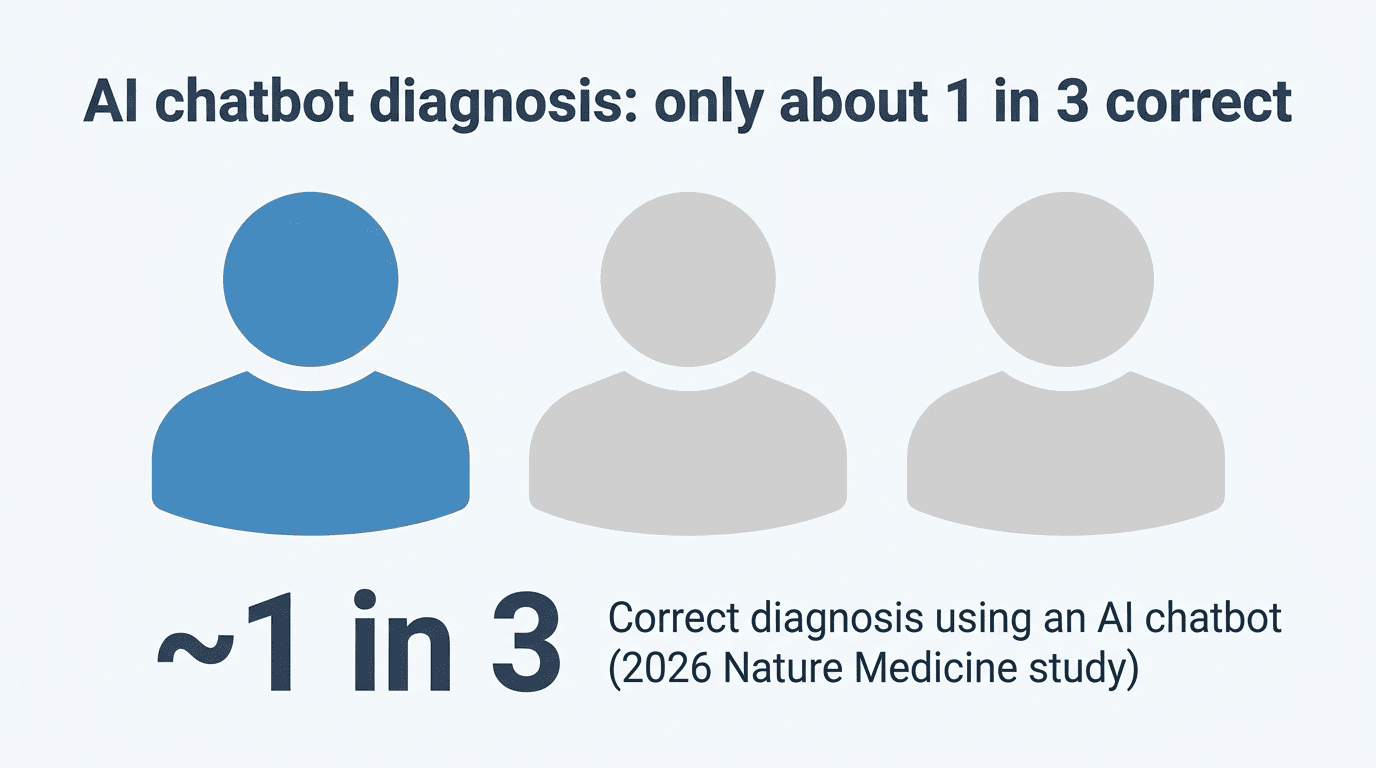
The known failure points cluster around a few recurring patterns:
- Confidently wrong answers with no visible uncertainty signal
- Rare or complex conditions underrepresented in training data
- Missing context an AI never had — prior history, physical exam findings, other results
- Users treating a plain-language explanation as a final verdict instead of a starting point
None of this makes an AI health assistant useless — it makes it a tool for understanding language, not a tool for making the call.
How to Use an AI Doctor Safely
Used correctly, an AI doctor shortens the gap between getting a result and understanding it. Used incorrectly, it can talk you out of care you actually need.
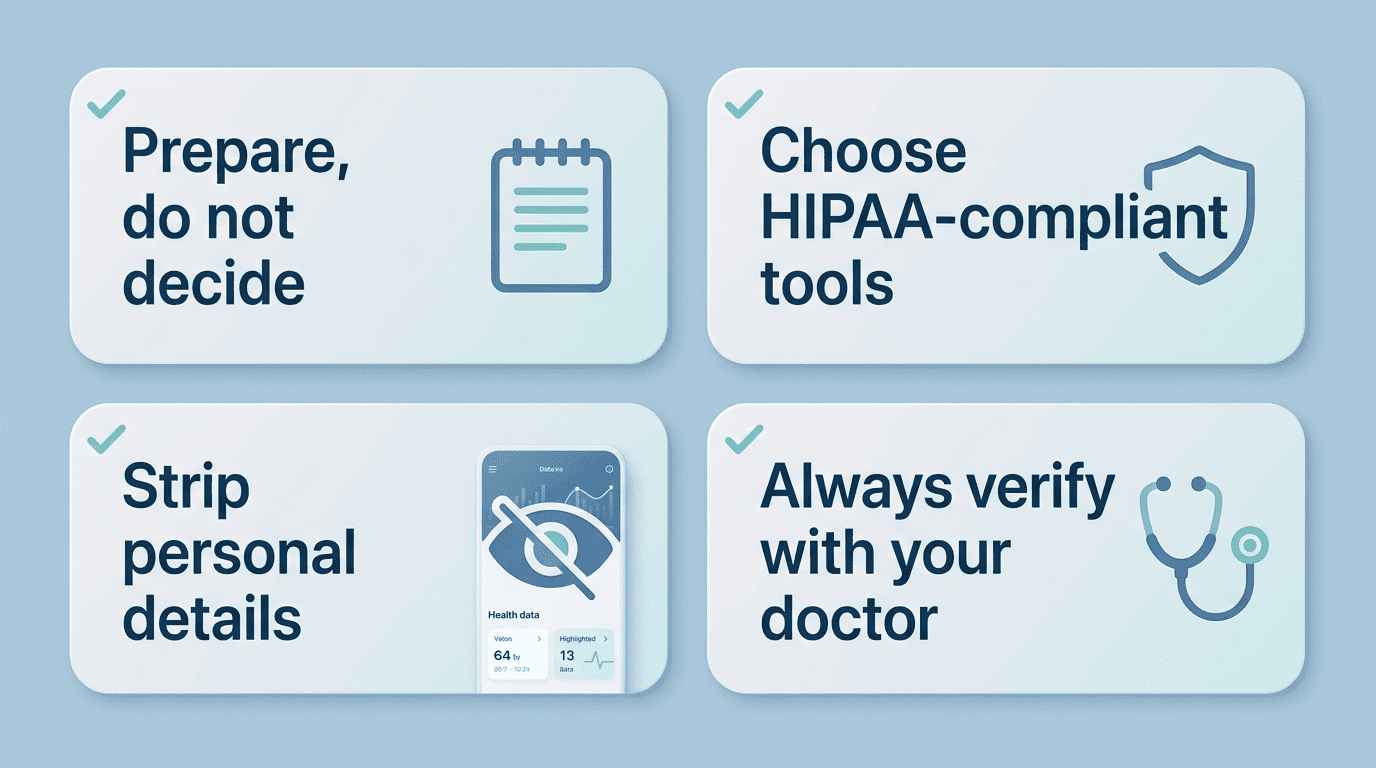
- Use it to prepare, not to decide. Under the 21st Century Cures Act information-blocking rule, lab results are released to you immediately — often before your doctor has even seen them — which makes it tempting to jump to conclusions the moment a number looks off. Use the AI to understand the terms and write down questions for your appointment, then let your physician interpret the result and decide what happens next.
- Protect your privacy. Prefer tools that state HIPAA compliance and confirm they don’t use your data to train public models. Strip personal identifiers when you’re using a general-purpose chatbot instead of a purpose-built medical tool.
- Cross-check anything that changes your behavior. Roughly a third of U.S. adults now use large language models for health questions, and more than 40 million people ask ChatGPT health questions every day — that scale is exactly why a second, human opinion matters before you skip an appointment or a medication.
- Watch for confident-sounding errors. An AI hallucination reads exactly like a correct answer, with no built-in signal that something is off; if an explanation contradicts what your doctor already told you, flag it rather than trusting the newer source by default.
These rules boil down to a simple split between what an AI doctor is good for and what it isn’t:
| Good use | Not a safe use |
|---|---|
| Understanding what a term or value means | Deciding whether to start or stop a treatment |
| Preparing specific questions before an appointment | Skipping a doctor’s visit because the AI seemed confident |
| Getting a plain-language first read on a new result | Treating a single AI answer as a final diagnosis |
| Flagging something to ask about sooner rather than later | Ignoring a doctor’s advice because it contradicts the AI |
That table is really the whole safety model in one place: the left column is what an AI health assistant does well, the right column is where a licensed physician has to take over. Neither substitutes for the other, and the tools that are honest about that distinction are the ones worth trusting with something as personal as your own results.
Anthropic, the company behind the Claude model that powers Stanford Medicine’s tool, is direct about where that line sits. Its Usage Policy lists healthcare and medical diagnosis as a high-risk use case requiring qualified human review before any output is used, and a company spokesperson has put the same point in plain language:
Claude is not designed or marketed for making clinical diagnoses.
Anthropic spokesperson, quoted in Scientific American
Closing safety note
An AI doctor is not a substitute for a licensed physician and does not provide a diagnosis. For medical emergencies call 911. Always confirm any explanation with a real, licensed doctor before acting on it — an AI doctor can translate the language of your results, but only a physician can turn that into a diagnosis and a treatment plan.