
Can an AI Doctor Read Your Lab Results? What It Can and Can’t Do
Yes — an AI doctor can read your lab results, flag values that fall outside the normal range, and explain what a biomarker like ALT or LDL actually means in plain English. According to KFF Health News, patients are already doing this on their own, often before a physician has even called. When you ask an AI doctor to review a blood panel, it turns a wall of numbers into readable context in under a minute.

An AI doctor is not a substitute for a licensed physician and does not provide a diagnosis. For medical emergencies call 911. Use it to understand your results and prepare better questions — then confirm anything that matters with your real doctor.
Yes, an AI Doctor Can Read Your Lab Results — Here’s What That Means
An AI doctor can genuinely process a lab report — but “reading” it means something narrower than diagnosing it. The AI assistant extracts values, compares them to reference ranges, and explains the biomarkers in language a physician would otherwise translate for you at a follow-up visit.
What “reading” a lab result actually looks like
An AI doctor extracts the values from your report — PDF, photo, or portal export — compares each against its reference range, flags what’s high or low, and explains it in plain language. Take a fasting glucose of 105 mg/dL: it sits just above the normal under-100 mg/dL cutoff, and the AI can tell you that’s “prediabetic range” territory worth discussing, not a diagnosis.
Why so many people already do this
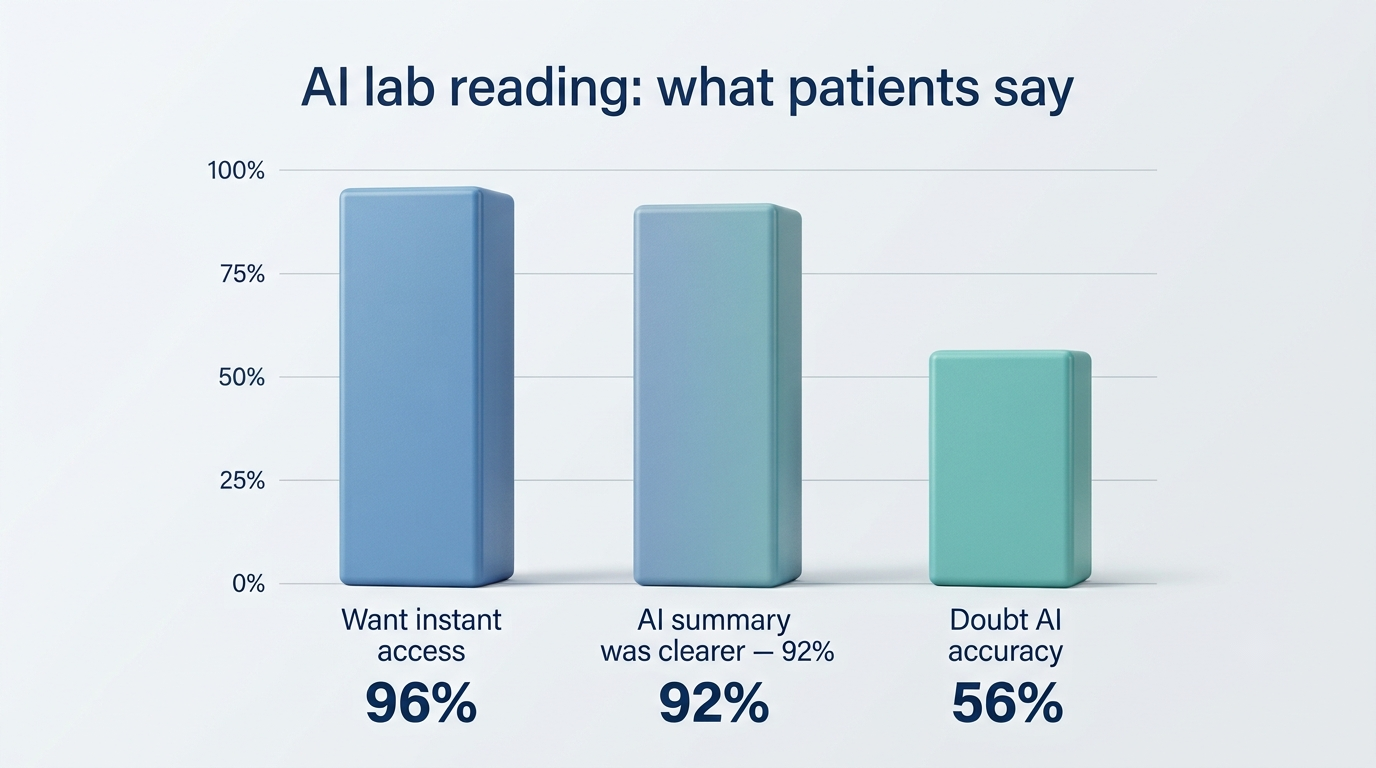
Roughly 1 in 7 adults over 50 now use AI to get health information, according to a University of Michigan poll — and younger adults lean on it even more: a separate KFF poll found adults under 30 are about three times as likely as adults 50 and older to use AI specifically for mental-health information (28% vs. 8%). Patients increasingly see results the moment they post to portals like MyChart — 96% of patients say they want that immediate access — and turn to an AI health assistant to decode the numbers before the doctor calls with an explanation. Even Stanford Health Care has launched an AI assistant that drafts lab-result interpretations for its own physicians, a sign that the same pattern-recognition work is moving into clinical workflows, not just consumer apps.
How an AI Doctor Reads a Lab Report
Under the hood, an AI lab result analyzer isn’t reading the way a person does — it’s running a pipeline that turns unstructured text (or a scanned image of text) into structured, comparable data points.
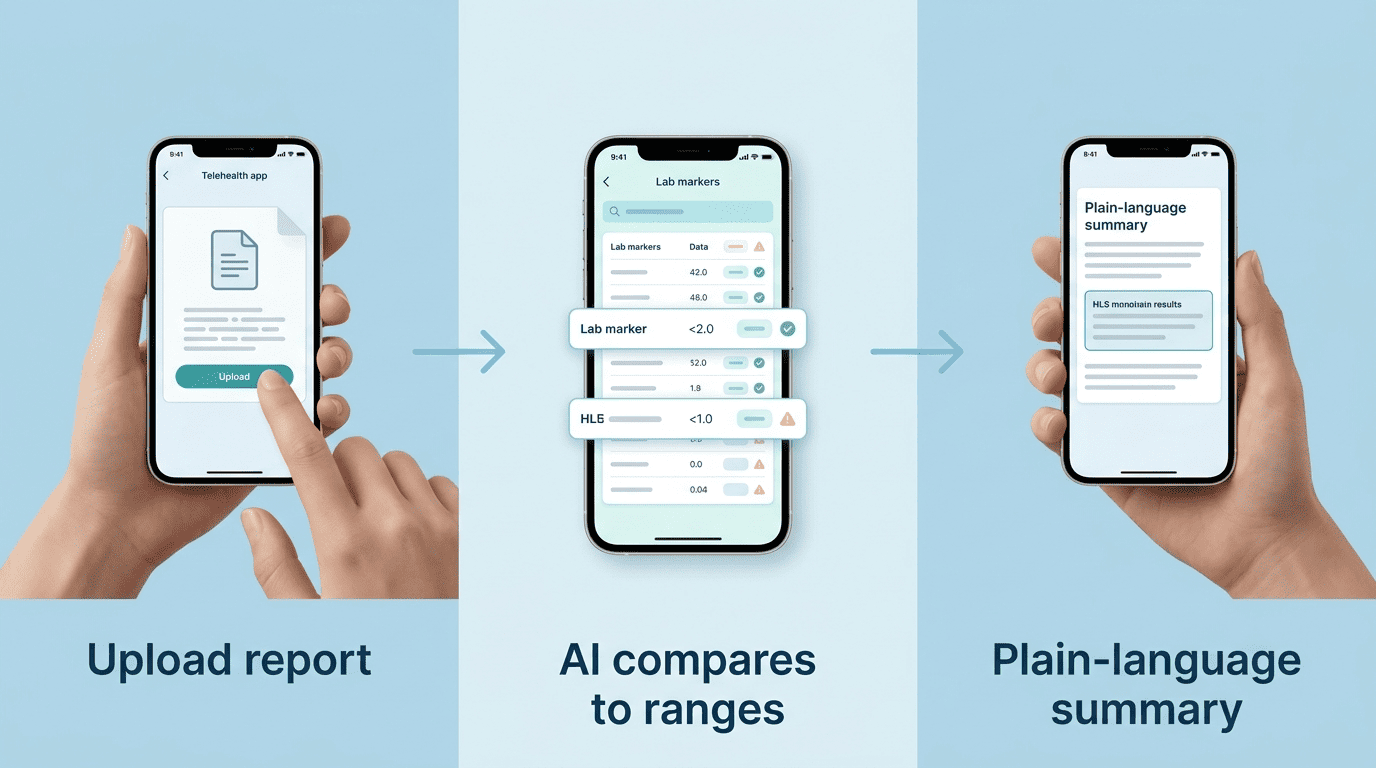
The three-step flow: upload, analyze, explain
An AI-powered lab report reader follows a consistent pattern:
- You upload the report as a PDF or photo, or paste the values directly.
- The AI uses OCR (optical character recognition) and natural language processing to identify each marker and match it against medical reference ranges.
- It returns a plain-language summary flagging out-of-range values, trends across previous results, and which markers relate to each other.
Most tools return this summary in under 30 seconds, which is exactly why the format has caught on faster than most patient-education efforts of the past decade.
What it can and can’t ingest
An AI doctor handles text-based lab reports well: a complete blood count (CBC), comprehensive or basic metabolic panel, lipid profile, HbA1c, liver function markers (ALT/AST/GGT), thyroid panel (TSH/T3/T4), PSA, and vitamin levels. What it generally cannot do is interpret raw MRI, CT, ultrasound, or X-ray images, or raw ECG waveform signals — those require specialized imaging AI, not a general AI lab analysis tool reading a written report. Knowing that boundary before you rely on it saves you from expecting more than the tool is built to deliver.
| Report type | Can an AI doctor read it? |
|---|---|
| CBC, metabolic panel, lipid profile | Yes — text-based, structured values |
| HbA1c, thyroid panel (TSH/T3/T4), PSA | Yes — text-based, structured values |
| Raw MRI, CT, or ultrasound images | No — requires specialized imaging AI |
| Raw ECG waveform signal | No — requires signal-processing AI |
What an AI Doctor Can Actually Tell You
Once the values are extracted and compared, the useful part starts: turning a spreadsheet of numbers into something you can act on before your next appointment.
Plain-language explanations of each biomarker. It translates “elevated LDL cholesterol” into what LDL actually is, why it matters, and how far outside the range your number falls. That’s useful for understanding your own body, preparing sharper questions, and tracking how a marker changes between tests.
Trends and connections, not verdicts. An AI doctor can connect several markers into a broader picture — glucose, insulin, and HbA1c together, for instance — and chart how they’ve moved across past results. Framed correctly, this is a connected set of factors worth discussing with a specialist, not a diagnosis or a treatment plan — a separate task where an AI doctor can explain what a diagnosis means once a clinician has actually made one. The distinction matters: connecting dots is pattern recognition, and deciding what those dots mean for your care is medicine.
How Accurate Is an AI Doctor at Reading Labs?
Accuracy is where the AI lab result interpreter gets genuinely mixed reviews, and the honest picture sits somewhere between “impressively helpful” and “occasionally wrong in a confident-sounding way” — the same mixed verdict you find when you look at how accurate an AI doctor is at diagnosis more broadly.
The honest answer: helpful, but imperfect
In a Colorado radiology study, 108 of 118 patients said that ChatGPT summaries clarified their reports. But the same study found the AI sometimes overemphasized or underemphasized findings, and a small but significant number of patients came away more confused than before. That tracks with a broader trust gap: 56% of people who use AI for health information say they aren’t confident it’s accurate, according to a 2024 KFF survey.
A few signs your AI summary needs a second look before you act on it:
- It states a conclusion without pointing to a specific value or range
- The tone shifts dramatically between two similar-sounding questions
- It doesn’t mention checking with a doctor for anything abnormal
- It contradicts a plain reading of the report’s own reference range column
Large language models can give truly terrible advice depending on how they’re prompted.
Dr. Adam Rodman, Harvard internist
Where it goes wrong: hallucinations and bad prompts
LLMs can hallucinate — produce a confident, well-written answer that is simply wrong. OpenAI’s Whisper transcription model once inserted an imaginary medical treatment into a transcript that was never actually said. That risk is exactly why an AI doctor should function as a second read, never the final word, on anything that affects a medical decision.
How to Ask an AI Doctor So the Answer Is Reliable
The way you prompt an AI health assistant changes how reliable the answer is — this isn’t a minor detail, it’s the difference between a useful summary and a misleading one.
Prompt like a pro: persona + one question at a time
Research from OpenNotes’ Liz Salmi found that accuracy improved when patients told the AI to take on the persona of a clinician and asked one question at a time, rather than dumping an entire report and hoping for the best. It also helps to verify important answers across a second model and against your actual care team before treating anything as settled.
Here’s a short step-by-step you can follow the next time you get results back:
- Remove identifying details — name, date of birth, Social Security number — before pasting anything into a general chatbot.
- Upload the report or paste the raw values, not a summary you wrote from memory.
- Ask the AI to take on a clinician persona and explain one marker at a time.
- Ask specifically which values are outside the reference range and by how much.
- Ask what questions you should bring to your doctor about those values.
- Cross-check anything that sounds alarming with a second AI model or a nurse line.
- Bring the summary to your appointment instead of acting on it alone.
Build “digital health literacy”
Treat AI output as a draft, not a verdict: ask follow-up questions, cross-check surprising claims, and bring the summary into the room at your appointment. The real skill here isn’t blind trust in the AI doctor app — it’s knowing how to question the answer it gives you.
Is It Safe and Private to Upload Lab Results?
Privacy is a legitimate concern with any AI lab analysis, and the answer depends heavily on which tool you’re using.
General chatbots vs purpose-built health tools
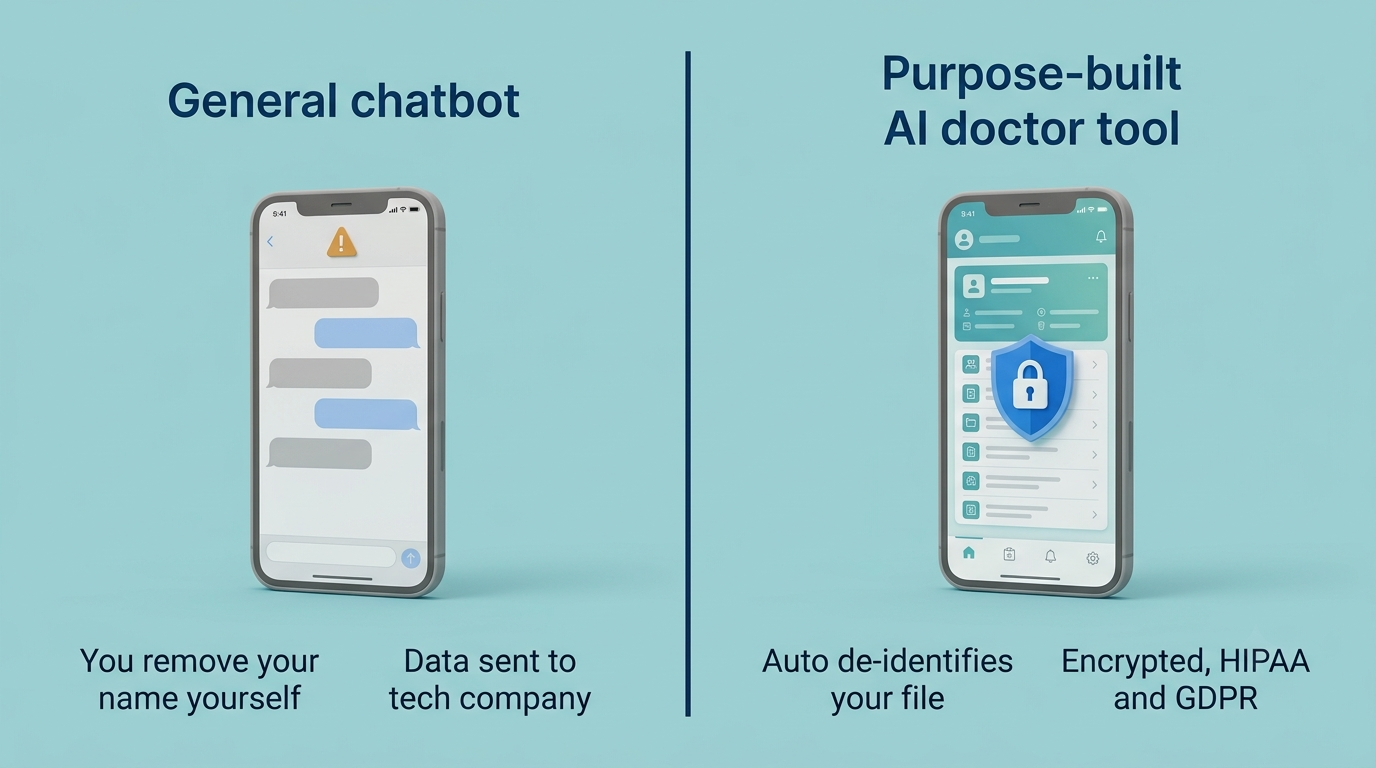
General-purpose LLMs send your prompt to a tech company’s servers, so remove your name, date of birth, and Social Security number before you paste anything in. Purpose-built AI doctor tools typically de-identify files automatically, encrypt data in transit and at rest, and claim alignment with HIPAA, GDPR, or SOC 2 standards — but read the privacy policy before you trust that claim. Dr. Rodman has said he’s aware of no consumer AI product that fully complies with federal health-privacy law, which is a reasonable baseline of caution to keep, regardless of which AI doctor app you choose.
Before you upload anything, it helps to run through a short checklist:
- Strip your name, date of birth, and Social Security number from the file or the pasted text
- Check whether the tool states it de-identifies or encrypts uploads
- Look for a stated alignment with HIPAA, GDPR, or SOC 2 — not just a general “privacy-first” claim
- Avoid pasting results into a browser extension or unofficial third-party wrapper around a chatbot
| General-purpose chatbot | Purpose-built AI doctor tool | |
|---|---|---|
| De-identification | Manual — you do it yourself | Often automatic |
| Encryption in transit/at rest | Not guaranteed | Typically standard |
| HIPAA/GDPR/SOC 2 alignment | Not designed for it | Often claimed — verify in the policy |
When You Must See a Real Doctor
An AI doctor is not a substitute for a licensed physician and does not provide a diagnosis. For medical emergencies call 911. Any critically abnormal lab value, a serious or new symptom, pregnancy, or a child’s results always warrant a real doctor’s review — an AI health assistant is not built to weigh those situations the way a clinician who knows your full history can.
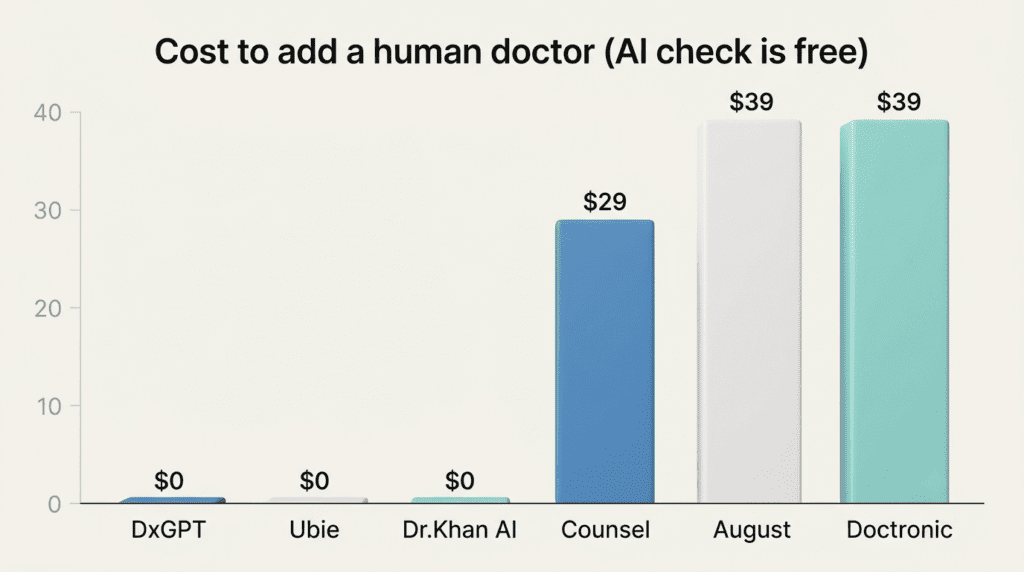
Use the AI to prepare — to understand the numbers, flag your questions, and walk into the appointment informed — then let a licensed clinician make the actual decision.